[ BEYOND THE ROOM · RESEARCH ]
The Missing Layer in the Hotel Technology Stack
Beyond the Room research · By Philip Beck
Hotels have spent decades building technology to sell rooms and run restaurants. They have very little for everything else guests buy. A guest can book a room on the hotel's website, check in on its app and earn points through its loyalty program, then book the dinner, the tour, the cabana and the spa appointment somewhere else. The hotel's digital relationship with the guest is weakest exactly when the guest starts spending in the destination.
That gap has always cost hotels revenue. As AI systems start recommending and booking travel on travelers' behalf, it will also start costing them visibility.
Hospitality technology has come in waves
Wave 1: digitize the room. Central reservation systems (CRS), property management systems (PMS) and revenue management systems (RMS) moved reservations, operations and pricing online.
Wave 2: own the guest relationship. Loyalty programs, CRM, mobile apps, digital check-in, guest messaging and personalization strengthened the direct connection between hotel and guest.
Wave 3: AI and data. The industry is now investing heavily in artificial intelligence, automation and enterprise data infrastructure.
Between waves 2 and 3, one layer is missing: infrastructure for managing the commerce that surrounds the stay.
The stack today
| What the guest buys | Technology most hotels have |
|---|---|
| Rooms | PMS, CRS, RMS, channel manager, booking engine, CRM, loyalty |
| Restaurants & bars | POS and related operating systems |
| Everything else: meeting space outside peak periods, pools and cabanas, parking, day-use, wellness, rooftops, hotel-created packages, local experiences, tours, transport | Largely nothing. Handled manually, by individual departments, through separate third-party platforms, or not at all |
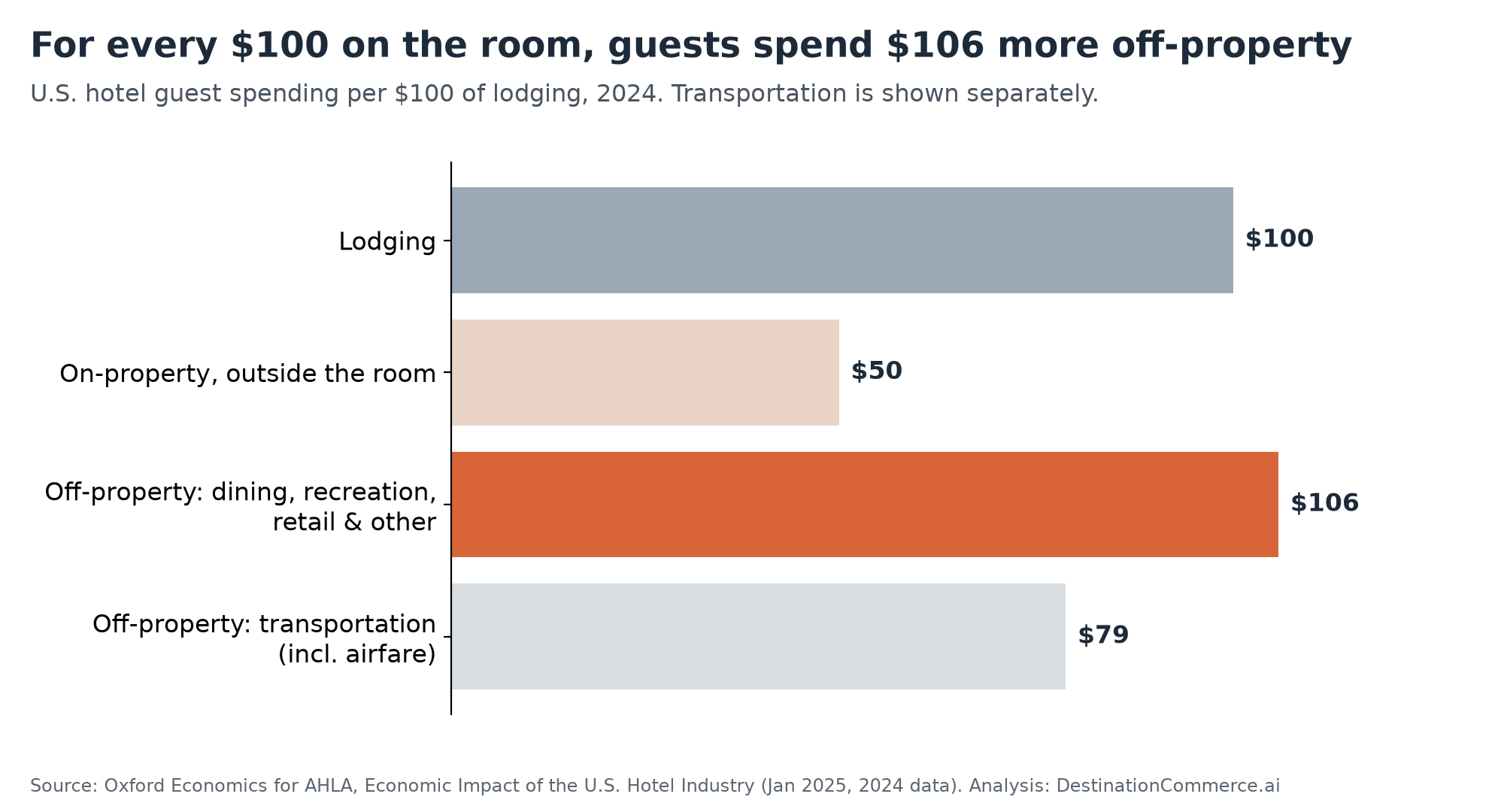
The "everything else" row is not small. For every $100 U.S. hotel guests spend on lodging, they spend about $50 more at the hotel outside the room and about $106 more off-property on dining, recreation, retail and other goods and services, before transportation.¹ Across the U.S., we estimate hotels could transact $27.3 billion a year through their own branded marketplaces.²
Why the gap exists
- Each department runs its own system. The spa, events, parking and recreation teams each have their own tools, if they have any, and none of them connect to what guests see online.
- The inventory isn't standard. A cabana, a 2pm meeting room slot and a sunset kayak tour don't fit the room-night model that hotel systems are built around.
- Local partners aren't in the hotel's systems. The businesses a hotel recommends every day have no connection to its systems, so referrals can't be booked, tracked or paid out.
- Nobody owns it. Rooms have a revenue manager and F&B has a director. Destination commerce usually has no one responsible for it.
The missing layer: a hotel-branded commerce layer
What's missing is a commerce layer: a marketplace that sits alongside the PMS, booking engine and loyalty program. It doesn't replace them. It connects:
- hotel-controlled assets (spaces, amenities, capacity),
- hotel-created offerings (packages, programs, experiences), and
- third-party local commerce (the businesses the hotel vouches for),
through a single branded environment covering discovery, merchandising, booking, payment, fulfillment and measurement. The hotel stays the brand the guest trusts, and becomes the marketplace operator rather than just a referral source.
That's the practical definition of destination commerce.
Why this matters more now: agentic commerce
How people discover and buy is starting to change. Search is increasingly being supplemented by AI systems that understand intent, make recommendations, and increasingly help with or carry out transactions for the user. This is often called agentic commerce.
McKinsey describes agentic commerce as shopping in which AI agents help consumers work through choices, make recommendations and, over time, carry out transactions that reflect what the person wants.³ Payment networks are building the infrastructure for it: Visa has announced technology intended to let AI agents discover, initiate and complete transactions with appropriate trust and controls.⁴
For hotels, the implication is straightforward: an AI agent can only recommend and book what it can read. Inventory that exists as a PDF spa menu, a "call the front desk" line, or a concierge's personal contacts is effectively invisible to it.
| AI agents can work with... | AI agents can't work with... |
|---|---|
| Structured offerings with descriptions, prices and policies | PDF menus and brochure pages |
| Live availability | "Call to reserve" |
| Online booking and payment | Email chains and phone bookings |
| Verified providers and reviews | Recommendations that live in someone's memory |
A structured hotel marketplace does two jobs. It creates a direct digital sales channel built on the hotel's relationship with its guests. It also creates a structured commerce layer that AI systems can discover, recommend from, and eventually book through, on behalf of guests.
Why the data matters
Once destination commerce runs through one layer, it produces data most hotels have never had:
- which assets are actually generating revenue,
- which experiences guests buy,
- which local providers deliver,
- which categories are in demand, by season and guest type,
- which inventory to expand, and
- which offerings may influence room bookings.
That data can feed a hotel's existing analytics and AI tools, subject to its own privacy, security and governance rules. It turns what guests do in the destination from guesswork into something the hotel can manage.
Five hotel technology trends to watch
- Revenue beyond rooms and F&B gets its own systems, alongside PMS and POS.
- Hotels start acting as marketplace operators, curating local businesses instead of just referring guests to them.
- Structured inventory becomes a way to be found, as AI agents begin to shape travel choices.
- The concierge becomes a marketplace curator, with AI handling the logistics. Read more.
- Total revenue per guest becomes a headline metric, alongside RevPAR, as hotels measure their share of the whole guest economy rather than room nights alone.
FAQ
- What is a hotel tech stack?
- The set of systems a hotel uses to sell and operate: typically a PMS, CRS, revenue management system, channel manager, booking engine, CRM and loyalty platform for rooms, and POS for food and beverage. Most stacks have no dedicated layer for commerce beyond rooms and restaurants.
- What is agentic commerce in travel?
- AI agents that help travelers research, compare and increasingly book travel for them. For hotels, it means inventory has to be structured, available and bookable online to be recommended.
- How can hotels prepare for AI booking agents?
- Make everything the hotel sells structured and bookable online, including spaces, amenities, packages and trusted local partners, with clear descriptions, prices, availability and policies. A hotel-branded marketplace is one way to do that.
- Does a hotel commerce platform replace the PMS?
- No. A commerce layer works alongside the PMS, booking engine and loyalty program and covers what they don't: assets, offerings and local partner bookings beyond the room.
¹ Oxford Economics for the American Hotel & Lodging Association, Economic Impact of the U.S. Hotel Industry (Jan 2025, 2024 data); per-$100 figures calculated by DestinationCommerce. See Hotel guest spending.
² DestinationCommerce (DropDesk) model estimates, 2026. Modeled mature annual gross marketplace value, not forecasts. Methodology.
³ McKinsey & Company / QuantumBlack, "The Agentic Commerce Opportunity: How AI Agents Are Ushering in a New Era for Consumers and Merchants," October 17, 2025.
⁴ Visa, "Visa Announces New AI, Stablecoin and Token Innovations to Power Intelligent, Programmable Commerce at Visa Payments Forum," June 10, 2026; see also Visa Intelligent Commerce.
Media contact: hello@destinationcommerce.ai · Philip Beck is available for interview on hotel commerce and AI.
Cite: DestinationCommerce (DropDesk), "The Missing Layer in the Hotel Technology Stack," Beyond the Room, 2026. https://destinationcommerce.ai/research/hotel-technology-stack/
Related: Hotel Distribution & Channel Management · The AI Hotel Concierge · Hotel Industry Statistics 2026