[ BEYOND THE ROOM · RESEARCH ]
Hotel Industry Statistics 2026
Guest spending, revenue beyond the room, and the destination commerce opportunity · By Philip Beck
Key takeaways
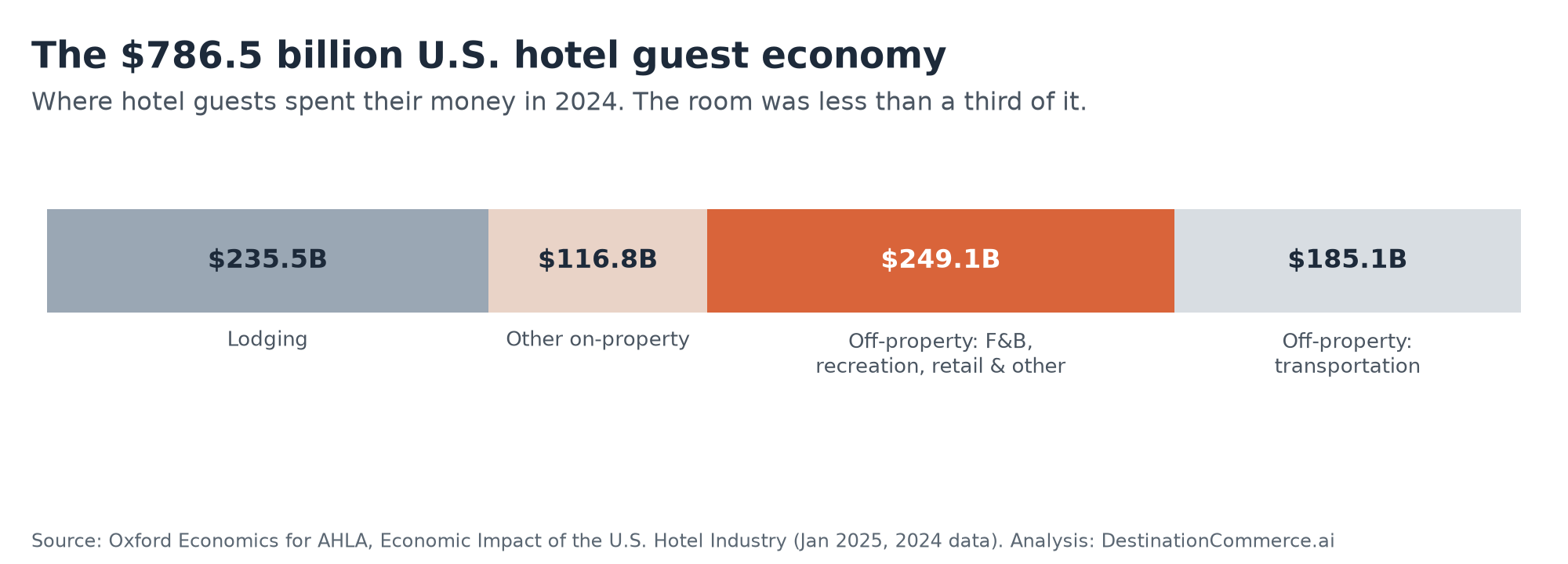
- U.S. hotel guests spent $786.5 billion in 2024. Lodging was $235.5 billion, less than a third of it.
- For every $100 spent on lodging, guests spent about $106 more off-property on dining, recreation, retail and other goods and services, before transportation.
- Guests spend more off-property on those categories ($249.1B) than they spend on hotel rooms.
- DestinationCommerce estimates U.S. hotels could transact $27.3 billion a year in destination commerce beyond rooms and ordinary F&B.
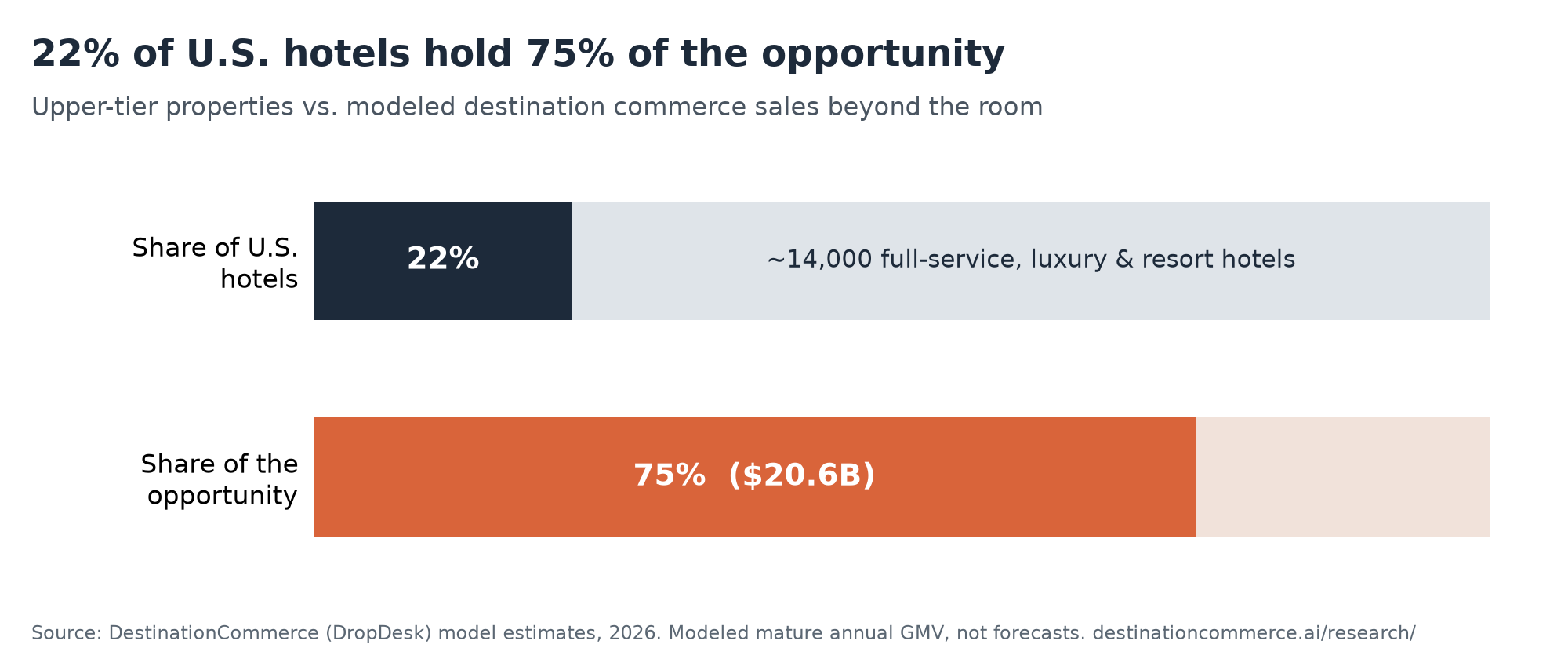
- 22% of U.S. hotels hold 75% of that opportunity.
U.S. hotel industry size
- There are more than 64,000 hotels in the United States.¹
- U.S. hotels have approximately 5.7 million guestrooms.¹
- U.S. hotels sold almost 1.3 billion room nights in 2024.¹
- U.S. hotel guests spent $786.5 billion in 2024, counting spending at the hotel and throughout the trip.¹
Hotel guest spending
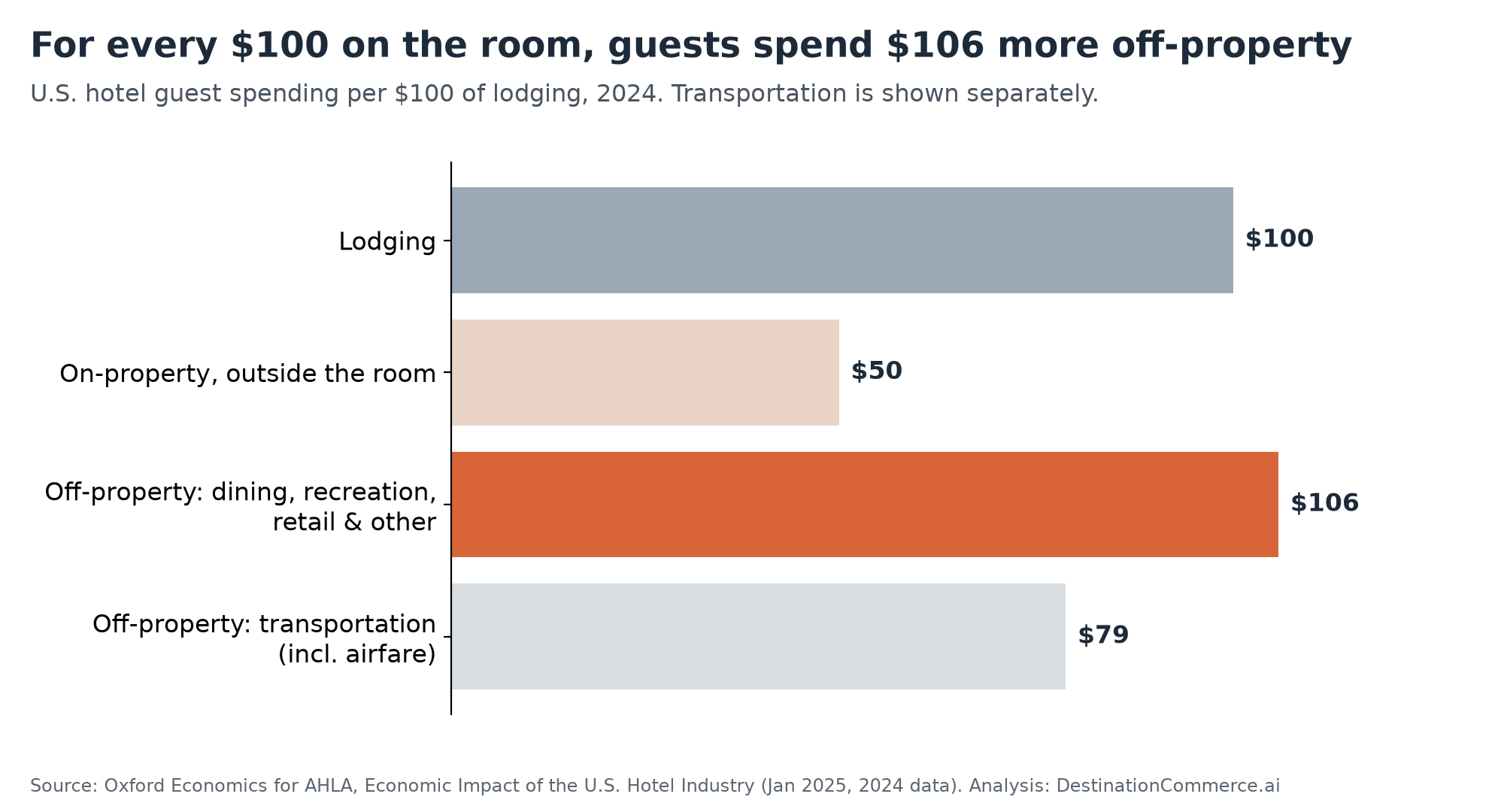
- U.S. hotel guests spent $235.5 billion on lodging in 2024.¹
- Lodging accounted for about 30% of total U.S. hotel guest spending.¹ ²
- For every $100 U.S. hotel guests spend on lodging, they spend about $106 more off-property on food and beverage, recreation, retail and other goods and services, before transportation.¹ ²
- U.S. hotel guests spent $249.1 billion off-property on food and beverage, recreation, retail and other goods and services in 2024. That is more than they spent on hotel rooms.¹ ²
- Total off-property spending by U.S. hotel guests, including transportation, was $434.2 billion in 2024.¹
- Transportation accounted for $185.1 billion of off-property spending. That category includes airfare.¹
- Hotel guests spent $352.3 billion on-site at hotels in 2024, including lodging.¹
- Guests spent $116.8 billion at hotels on things other than the room, about $50 for every $100 of lodging.¹ ²
- More than half (55%) of every dollar U.S. hotel guests spend is spent away from the hotel.¹ ²
Hotel revenue beyond the room
- Upper-upscale U.S. hotels earn about $92 in food and beverage revenue per occupied room. Luxury hotels earn about $220.³
- Hotels already have mature technology for rooms (PMS, CRS, revenue management, CRM, loyalty) and for restaurants (POS). Commerce beyond rooms and ordinary F&B, such as meeting space outside peak periods, pools and cabanas, parking, day-use, wellness and local experiences, is usually handled manually, by individual departments, through third-party platforms, or not at all.²
The destination commerce opportunity
The figures below are Destination Commerce model estimates of mature annual gross marketplace value (GMV), not forecasts. Methodology
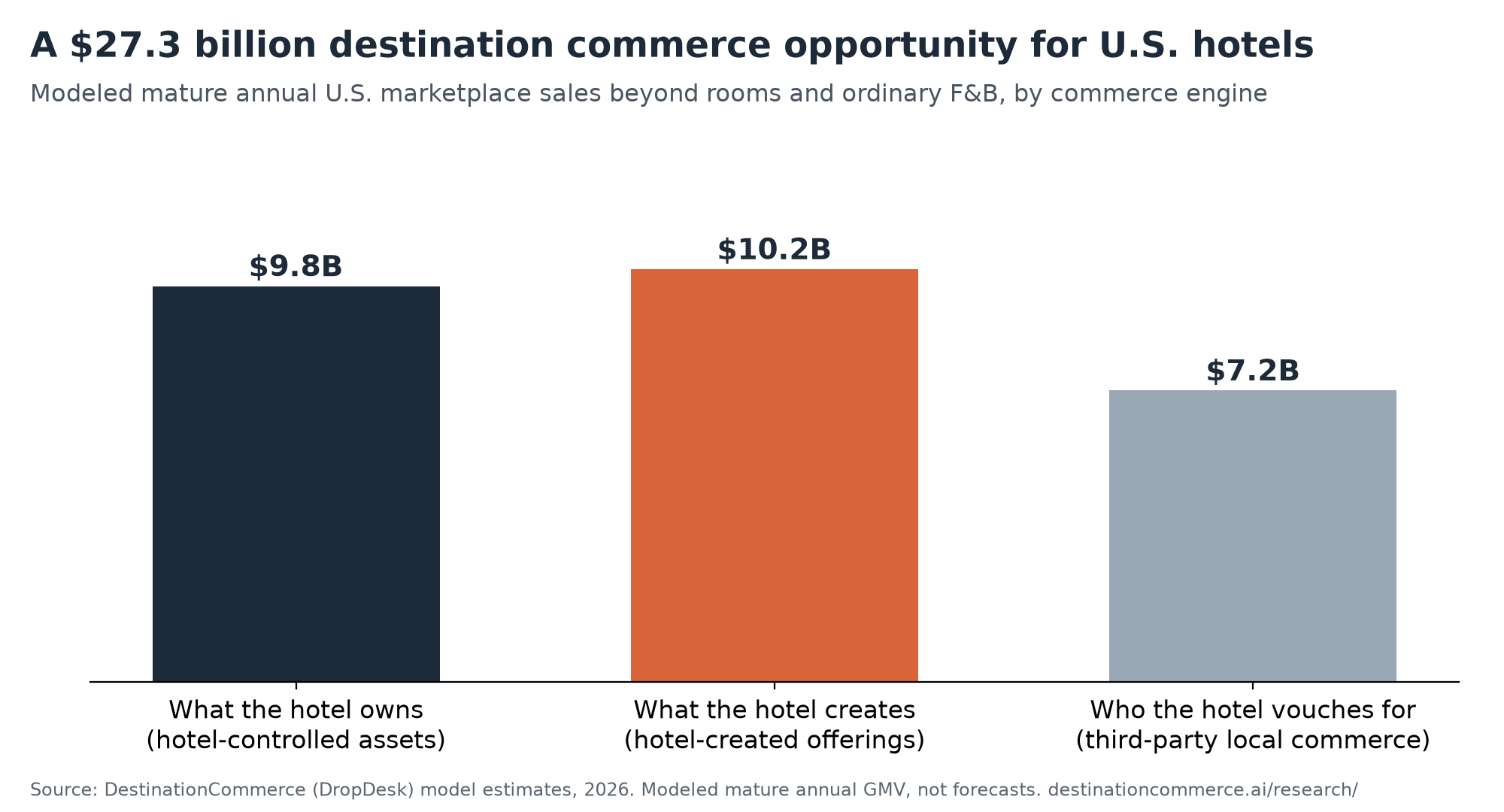
- U.S. hotels could transact an estimated $27.3 billion a year in destination commerce, meaning sales beyond rooms and ordinary food and beverage.²
- $9.8 billion of that opportunity comes from hotel-controlled assets hotels already own, such as meeting and event space, pools and cabanas, parking, day-use rooms, rooftops and wellness facilities.²
- $10.3 billion comes from hotel-created offerings: packages, programs and experiences hotels design themselves.²
- $7.2 billion comes from third-party local commerce: tours, dining, transport, wellness, guides and other local businesses a hotel recommends.²
- About 14,000 full-service, luxury/lifestyle and resort properties, 22% of U.S. hotels, account for about 75% ($20.6 billion) of the opportunity.²
- Of the $27.3 billion, an estimated $12.4 billion (45%) would be retained directly by hotels.²
- An estimated $10.6 billion (39%) would flow to independent local businesses, such as tour operators, restaurants, guides and wellness providers.²
- Within the upper-tier segment alone, hotels would retain an estimated $9.7 billion a year directly.²
- The model assumes hotels put only 2.5–3.7% of their existing non-room revenue through a marketplace. It does not depend on moving existing hotel revenue onto the platform.²
- The model counts no increase in room revenue, occupancy or RevPAR. Any such benefit would be additional.²
Guest experience and hotel performance
- Hotel guest satisfaction is driven by the whole stay: rooms, amenities, food and beverage, service and perceived value (J.D. Power 2025 North America Hotel Guest Satisfaction Index Study).⁴
- Research from the Cornell Center for Hospitality Research associates improvements in a hotel's online reputation with greater pricing power and improved RevPAR.⁵
- The evidence shows association, not causation. No published study yet shows that adding a hotel-owned marketplace causes a specific RevPAR increase, which is why the DestinationCommerce model excludes it.²
FAQ
- How much do hotel guests spend beyond the room?
- U.S. hotel guests spent $786.5 billion in 2024, of which $235.5 billion was lodging. For every $100 on lodging, they spent about $50 more at the hotel outside the room and about $106 more off-property on dining, recreation, retail and other goods and services, before transportation.
- What percentage of hotel guest spending is the room?
- About 30%. Lodging was $235.5 billion of the $786.5 billion U.S. hotel guests spent in 2024.
- How big is the hotel non-room revenue opportunity?
- DestinationCommerce estimates U.S. hotels could transact $27.3 billion a year beyond rooms and ordinary food and beverage, across hotel-owned assets, hotel-created offerings and local partner commerce. About $12.4 billion of that would be retained directly by hotels.
- What is destination commerce?
- Destination commerce is a hospitality business model in which a hotel participates economically in everything its guests do: selling not only rooms, but the spaces it owns, the experiences it hosts, and the local businesses it vouches for, through its own branded marketplace. Read the full definition.
Methodology & sources
¹ Oxford Economics for the American Hotel & Lodging Association, Economic Impact of the U.S. Hotel Industry (January 2025, 2024 data), p. 16. Guest spending based on Longwoods International data and Oxford Economics estimates.
² DestinationCommerce analysis. Percentages and per-$100 figures are calculated from Oxford Economics data. Opportunity figures come from DestinationCommerce (DropDesk) model estimates in Destination Commerce, white paper v3.3 (September 2026): a bottom-up model across U.S. hotel tiers and three commerce engines, cross-checked against hotel operating benchmarks. The figures are modeled mature annual GMV, not forecasts. Full methodology.
³ STR data reported by CoStar News, "As Guests Prioritize Experiences, Hotel Food-and-Beverage Experts Advise Knowing Market Needs," August 27, 2025.
⁴ J.D. Power, 2025 North America Hotel Guest Satisfaction Index Study, as reported by Hotel Dive.
⁵ Cornell Center for Hospitality Research, research on online reputation, pricing power and RevPAR.
Why we exclude transportation from the headline. Oxford Economics' $185.1 billion transportation category includes airfare, which hotels can't realistically address. We also say "off-property" rather than "local", because Oxford notes guest spending reaches destinations and areas along the trip route.
Free to use. You're welcome to cite any statistic or embed any chart on this page with a link to this page. Detailed model assumptions are available to journalists and analysts on request, under embargo or on background.
Cite this page: DestinationCommerce (DropDesk), "Hotel Industry Statistics 2026," Beyond the Room, 2026. https://destinationcommerce.ai/research/hotel-industry-statistics/
Media contact: hello@destinationcommerce.ai · Philip Beck is available for interview.