[ BEYOND THE ROOM · RESEARCH ]
The AI Hotel Concierge: Why AI Will Promote the Concierge, Not Replace Them
Beyond the Room research · By Philip Beck
Few jobs in hospitality combine guest service, local knowledge, commercial influence and personal judgment the way the concierge's does. A great concierge knows which restaurants, guides and attractions exist, and also which ones suit this particular guest. They've built relationships with local businesses over years, and they step in when plans change.
That knowledge is also one of the hardest things in a hotel to scale. Recommendations are given verbally. Vendor relationships live in one person's phone. Checking availability means phone calls. Outcomes aren't recorded. When an experienced concierge leaves, much of what they know leaves with them.
The usual answer is a chatbot. We think that's the wrong answer. AI's real role is to turn the concierge from a booking agent into a marketplace curator.
A century of unpaid referrals
The concierge has always been the hotel's link to its destination. Every day, concierges send guests to restaurants, tour operators, spas, drivers and attractions. U.S. hotel guests spend about $106 off-property for every $100 they spend on the room, $249 billion a year on dining, recreation, retail and other goods and services.¹ A large share of those decisions is shaped by hotel staff.
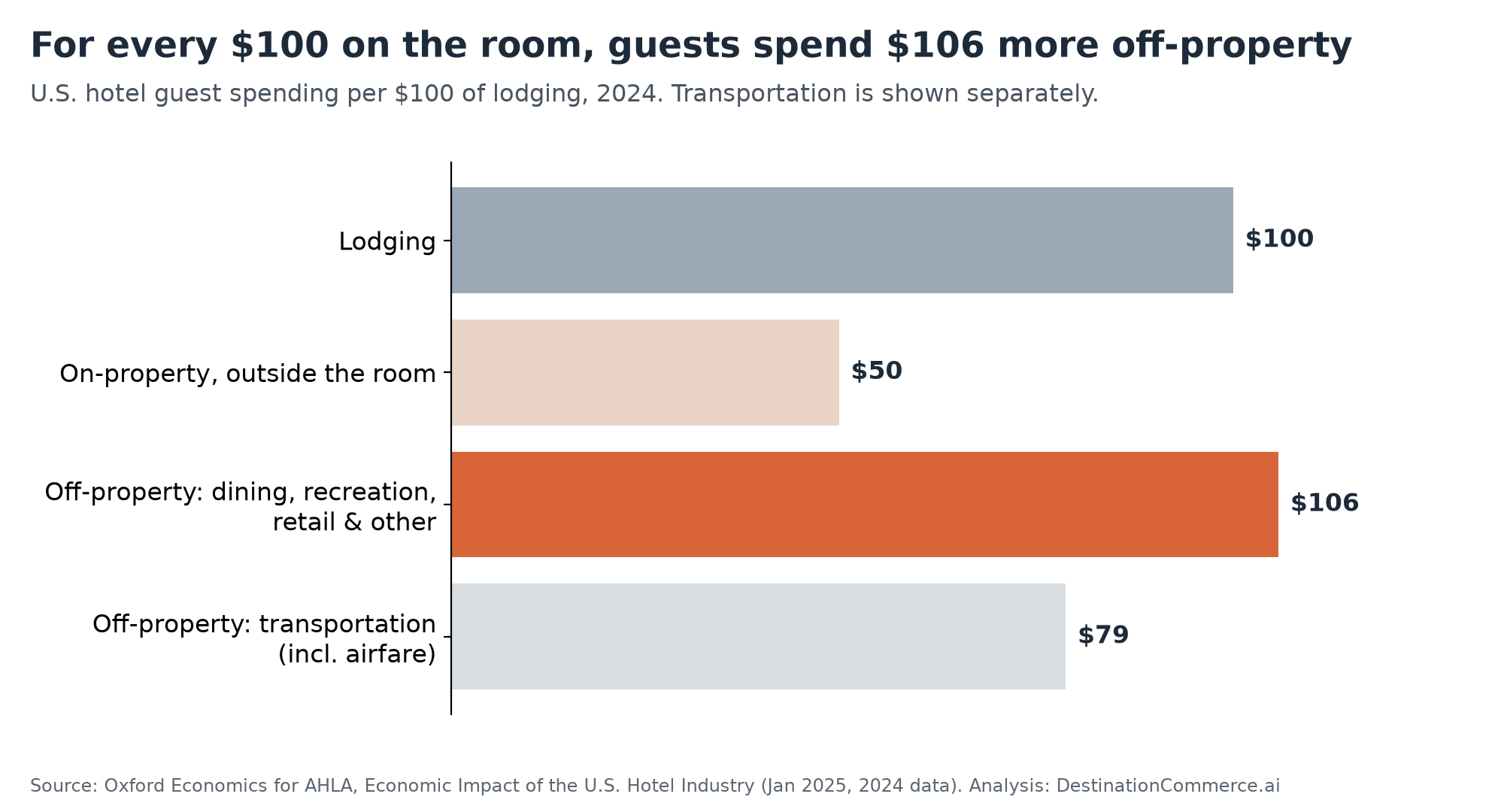
Yet in most hotels those recommendations produce no booking the hotel can see, no data, and no revenue. The hotel's advice is one of the most influential in the destination, and the hotel doesn't earn from it.
The traditional model: one guest, one request, start again
In the traditional model, the concierge handles each transaction personally:
- The guest asks.
- The concierge recalls options, calls around and checks availability.
- The concierge books by phone or email, or just hands over a name.
- Nothing is recorded. The next guest starts from scratch.
It's personal and it works, but it doesn't scale. The concierge can serve one guest at a time, and time spent on the phone chasing availability is time not spent using judgment.
The destination commerce model: a persistent marketplace
In a destination commerce model, the hotel runs a marketplace that stays in place between guests:
- Approved local providers are onboarded once, with agreed commercial terms.
- Offerings are digitized, with live availability, pricing and policies.
- Guests can book directly or through staff, under the hotel's brand.
- Each booking, review and service issue is recorded.
- Recommendations get better over time as the data builds up.
The concierge's job changes with it.
From booking agent to marketplace curator
Instead of spending most of the day finding information and arranging individual bookings, the concierge becomes the marketplace curator, the person responsible for the quality of the hotel's local offering.
| Curation responsibility | What it looks like |
|---|---|
| Supply quality | Deciding which providers join, which consistently deliver, and which get removed |
| Guest relevance | Choosing what to feature, and which experiences fit families, couples, business travelers and groups |
| Marketplace development | Spotting emerging demand, seasonal shifts and new package opportunities |
| Service control | Catching service failures and deciding when a person needs to step in |
The concierge is no longer serving one guest at a time. They're improving an offering that serves thousands of guests. That's a bigger job, and a better one.
Where AI fits: decision support, not a chatbot
Once suppliers, availability and bookings are recorded in a structured way, AI becomes useful.
Take a common request: a guest traveling with two children and an older parent wants an outdoor activity on Thursday afternoon.
A concierge working the traditional way has to think through weather, distance, transport, suitability for each age, accessibility, availability, price, the family's preferences, each provider's reputation, cancellation policies and feedback from past guests, mostly from memory and by phone.
An AI assistant working on structured marketplace data can check all of those at once. It can suggest three suitable options, explain why each one fits, and flag concerns ("this trail has one steep section", "this provider had two late cancellations last month").
The concierge then applies judgment and owns the relationship. The AI deals with the logistics. That's very different from replacing the concierge with a chatbot.
Not every hotel has a concierge, and it doesn't need one
If destination commerce depended on dedicated concierge teams, it would be limited to luxury hotels. It isn't. The curation role adapts to the property:
| Property type | Likely operating model |
|---|---|
| Luxury hotel | Concierge-led curation, supported by AI and commerce infrastructure |
| Resort | A dedicated experience and activity marketplace team |
| Full-service hotel | Guest relations, concierge or commercial team |
| Select-service hotel | Centrally curated marketplace with local property oversight |
| Limited-service hotel | Mainly a digital guest marketplace with regional administration |
| Hotel brand | Enterprise governance, technology, data standards and network management |
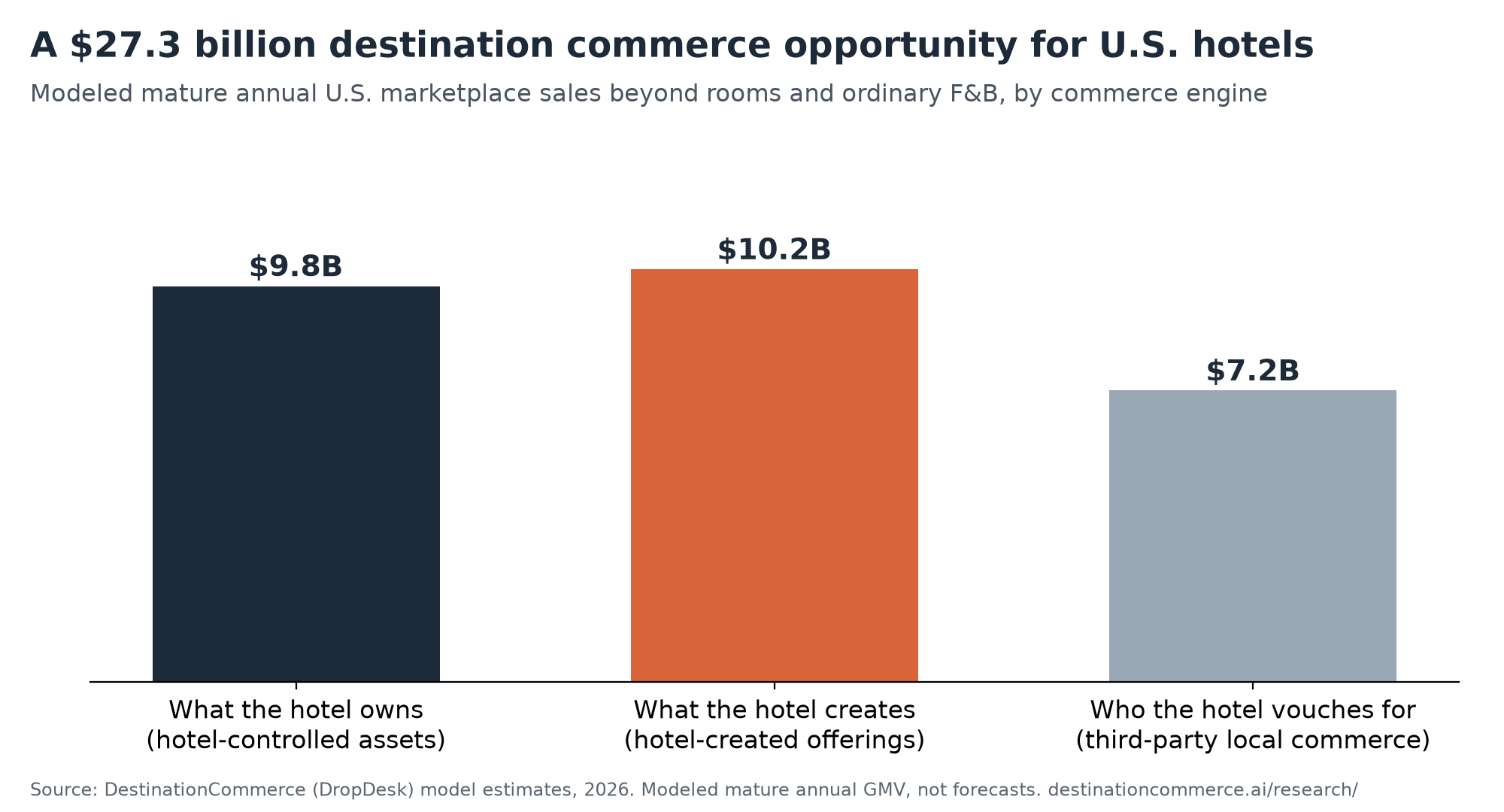
Because the same model works at every level, the opportunity extends across the industry. We estimate U.S. hotels could transact $27.3 billion a year in destination commerce, and third-party local commerce, the concierge's traditional territory, accounts for an estimated $7.2 billion of it.²
What hotels can do now
- List who you already recommend. Ask the concierge and front desk for the 20 businesses they send guests to most often. That list is where a marketplace starts.
- Record the recommendations you make. Even a simple log shows which categories guests want and where demand is going unmet.
- Write down the job. Rewrite the concierge job description around curation (supplier quality, featured offers, seasonal packages) and measure it by guest satisfaction and marketplace performance.
- Get your data structured before adding AI. AI can't recommend inventory it can't read. Structured, bookable offerings come first. Why that matters as AI agents start booking travel.
FAQ
- Will AI replace hotel concierges?
- We don't think so. AI is most useful as decision support: it checks availability, suitability, distance, policies and past feedback in seconds, while the concierge applies judgment and owns the guest relationship. The role moves from booking agent to marketplace curator.
- What is a marketplace curator in a hotel?
- The person, usually the concierge or guest relations team, who decides which local providers and hotel offerings the hotel stands behind, what to feature for which guests, and when to step in. They manage the quality of the hotel's destination marketplace.
- What is an AI hotel concierge?
- Software that uses AI to answer guest requests and recommend activities, dining and services. It works best when it draws on structured, bookable data from local providers the hotel has vetted, and when it supports human staff rather than replacing them.
- How do hotels earn from concierge recommendations?
- By turning recommendations into bookings through a hotel-branded marketplace, with revenue shared between the hotel and the local provider. That's the third-party local commerce engine of destination commerce.
¹ Oxford Economics for the American Hotel & Lodging Association, Economic Impact of the U.S. Hotel Industry (Jan 2025, 2024 data); per-$100 figure calculated by DestinationCommerce, excluding transportation. See Hotel guest spending.
² DestinationCommerce (DropDesk) model estimates, 2026. Modeled mature annual gross marketplace value, not forecasts. Methodology.
Media contact: hello@destinationcommerce.ai · Philip Beck is available for interview and bylines on the future of the concierge.
Cite: DestinationCommerce (DropDesk), "The AI Hotel Concierge: Why AI Will Promote the Concierge, Not Replace Them," Beyond the Room, 2026. https://destinationcommerce.ai/research/ai-hotel-concierge/
Related: Digital Concierge for Hotels · Selling Local Experiences · Hotel Industry Statistics 2026