[ BEYOND THE ROOM · RESEARCH ]
How Much Do Hotel Guests Spend? Inside the $786.5 Billion Guest Economy
Beyond the Room research, Drop 1 · By Philip Beck
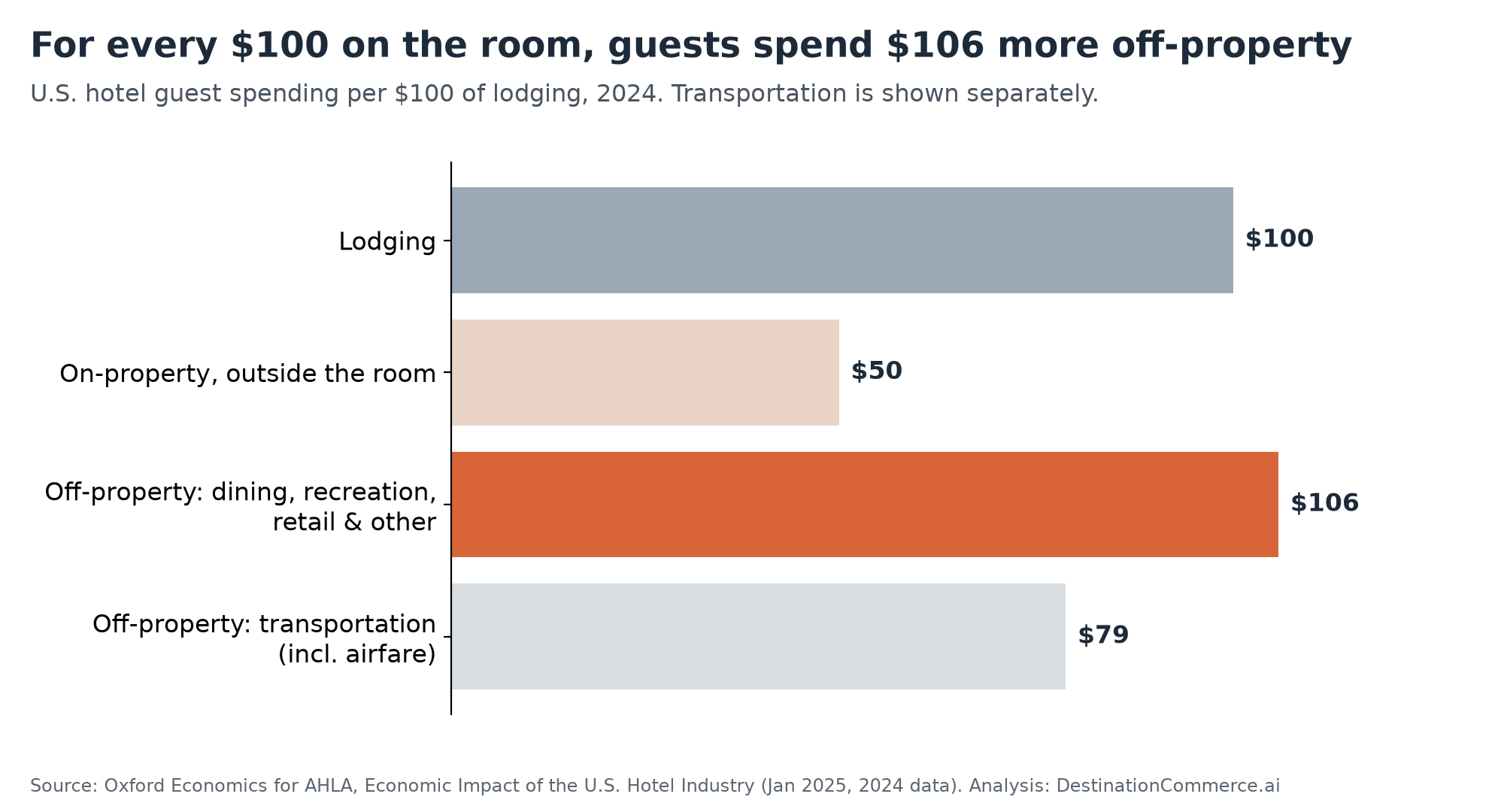
For every $100 a U.S. hotel guest spends on the room, they spend about another $106 off-property on dining, recreation, shopping and other goods and services, before counting transportation. That adds up to $249.1 billion a year, more than guests spend on hotel rooms themselves. Most of it goes to businesses and booking platforms the hotel has no commercial relationship with, even though the hotel brought the guest to the destination and is usually who the guest asks for advice.
This analysis breaks down where hotel guests' money goes, using Oxford Economics' latest figures for the American Hotel & Lodging Association, and explains why the gap matters for hotels.
The room is less than a third of what hotel guests spend
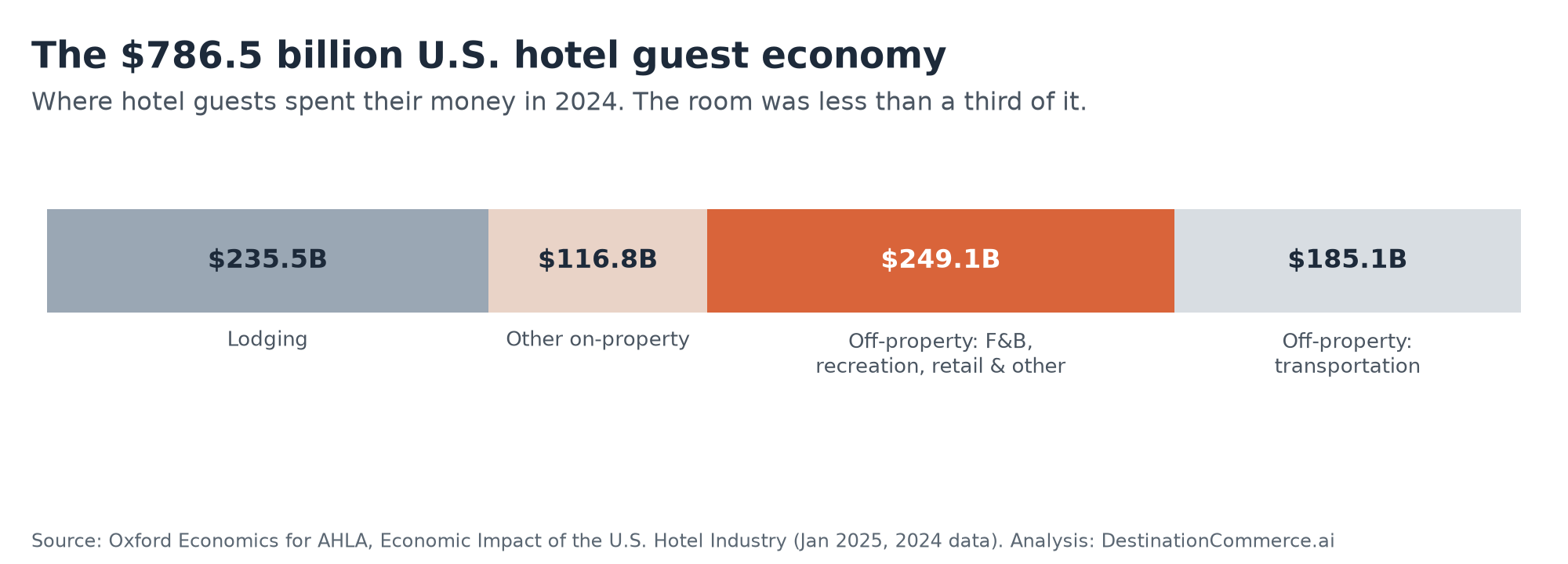
U.S. hotel guests spent $786.5 billion in 2024. Hotel rooms accounted for $235.5 billion of it, or about 30%.¹
The rest breaks down like this:
| Where the money went (2024) | Spending | Per $100 of lodging | Share of total |
|---|---|---|---|
| Lodging | $235.5B | $100 | 30% |
| At the hotel, outside the room (F&B, amenities, services) | $116.8B | ~$50 | 15% |
| Off-property: dining, recreation, retail & other | $249.1B | ~$106 | 32% |
| Off-property: transportation (incl. airfare) | $185.1B | ~$79 | 24% |
| Total | $786.5B | ~$334 | 100% |
Source: Oxford Economics for AHLA (Jan 2025); per-$100 and share figures calculated by DestinationCommerce. Shares may not sum exactly due to rounding.
Three things stand out.
1. Guests spend more on the destination than on the room. Off-property spending on food and beverage, recreation, retail and other categories ($249.1B) is higher than spending on lodging ($235.5B). If you include transportation, 55% of every dollar a hotel guest spends is spent away from the hotel.
2. Hotels already capture some spending beyond the room, but it's split up. Guests spent $116.8 billion at hotels on things other than the room. That's about $50 for every $100 of lodging, across restaurants, bars, spas, parking, meeting space and resort amenities. In most hotels each of these runs on its own system with its own booking process, and many can't be booked online at all.
3. The biggest share happens where the hotel has no role. The $249.1 billion spent off-property goes to restaurants, attractions, tours, shops and services. Guests usually book them through search engines, review sites, online travel agencies and experience platforms, many of which have never dealt with the guest before.
Why we leave transportation out of the headline
The widely quoted total for off-property spending is $434.2 billion, or about $184 for every $100 of lodging. We deliberately use the lower figure.
Oxford Economics' $185.1 billion transportation category includes airfare, which hotels can't realistically sell. Taking it out leaves $249.1 billion, which is closer to the dining, activities and shopping that happen during a stay. We also describe it as off-property spending rather than local spending, because Oxford notes that guest spending reaches destinations and areas along the trip route.
We think a conservative number is more useful: it's what hotels could plausibly take part in, not the largest total available.
The paradox: the hotel influences the spending but earns none of it
A hotel is often the most trusted commercial relationship a traveler has in a destination:
- It comes first. The guest chooses the hotel before most other trip decisions.
- It's where the guest is based. Every day of the trip starts and ends there.
- It gives advice. Concierges, front-desk staff, the hotel's website and app, and the brand's reputation all shape where guests eat and what they do.
- It has things to sell. Meeting rooms, pools, cabanas, parking, rooftops and wellness facilities are often empty for much of the day.
Yet the hotel's digital relationship with the guest is weakest just as the guest starts spending in the destination. The guest books the room on the hotel's website and may message the hotel through its app. Then they book the dinner, the tour and the spa appointment somewhere else.
For a century, concierges have recommended restaurants and tour operators without the hotel sharing in the revenue. The advice is valuable, but it rarely produces a booking the hotel can track or earn from.
What this means for hotels
This gap is the starting point for destination commerce: a hotel participates economically in more of what its guests do by selling the spaces it owns, the experiences it creates and the local businesses it vouches for, through its own branded marketplace.
Destination commerce doesn't mean the hotel should control every transaction in its destination. It means the transactions a hotel already influences, like the restaurant it recommends, the kayak tour it books by phone, or the cabana nobody can find on the website, can run through the hotel. The hotel earns from them, the local business still earns, and the guest gets a recommendation from someone they trust.
The $106 is not an estimate of what hotels could capture. It measures the wider economy around each stay. Our separate model of the addressable opportunity is much narrower: $27.3 billion a year across U.S. hotels.
Three questions for every hotel
- What can a guest book on your website, apart from a room? For most hotels the honest answer is very little.
- What do you own that sits empty? Meeting space outside peak periods, pool cabanas on weekdays, parking overnight, rooftops before sunset.
- Which local businesses do you already recommend, and do you know how many guests you send them? That referral relationship is what destination commerce is built on.
FAQ
- How much do hotel guests spend per trip beyond the room?
- Across the U.S. in 2024, for every $100 spent on lodging, hotel guests spent about $50 more at the hotel outside the room and about $106 more off-property on dining, recreation, retail and other goods and services, before transportation.
- How much do hotel guests spend in total?
- U.S. hotel guests spent $786.5 billion in 2024, according to Oxford Economics for the American Hotel & Lodging Association.
- What share of guest spending goes to the hotel?
- Guests spent $352.3 billion on-site at hotels in 2024 ($235.5B on lodging plus $116.8B on everything else), about 45% of total guest spending. The other 55%, $434.2 billion, was spent off-property.
- Why does this matter for hotel revenue?
- Room revenue is limited by the number of rooms and market rates. Guest spending beyond the room is larger than room spending and mostly goes to other businesses, which makes it the biggest growth opportunity that hotels already play a part in creating.
Methodology. All spending figures are from Oxford Economics for the American Hotel & Lodging Association, Economic Impact of the U.S. Hotel Industry (January 2025, 2024 data), p. 16, based on Longwoods International guest-spending data and Oxford Economics estimates. Per-$100 figures and shares are calculated by DestinationCommerce: off-property spending excluding transportation = $434.2B − $185.1B = $249.1B; $249.1B ÷ $235.5B × $100 = $105.8.
Use this research. Charts are free to embed with a credit link. Media contact: hello@destinationcommerce.ai · Philip Beck is available for interview.
Cite: DestinationCommerce (DropDesk), "How Much Do Hotel Guests Spend? Inside the $786.5 Billion Guest Economy," Beyond the Room, 2026. https://destinationcommerce.ai/research/hotel-guest-spending/
Related: Hotel Industry Statistics 2026 · The $27.3B Destination Commerce Opportunity · The Complete Guide to Hotel Ancillary Revenue