[ BEYOND THE ROOM · ORIGINAL RESEARCH ]
The Hotel Industry Issues Report 2026
What hotel staff and guests say goes wrong: a year of public conversation, ranked
Original research from DestinationCommerce · Published October 7, 2026 · By Graham Beck
Last updated
Hotels hear about their problems from two directions: the people who run them and the people who stay in them. Industry surveys tell us what owners worry about. Review sites tell us what guests rate. Neither tells you, in their own words and at scale, what goes wrong day to day for the people at the front desk and on the other side of it.
So we read the conversation directly. We collected 31,996 public Reddit posts from a full year (October 2025 to October 2026) in the communities where hotel staff and hotel guests talk about hotels. We coded 16,734 of them by who wrote the post, whether it described a problem, and which problems it raised. We then compared the results with industry surveys, U.S. labor data and search demand. Every figure below can be checked against our dataset, which is available on request.
Key findings
- Burnout, not the shortage itself, is what hotel staff talk about most. Burnout and poor management appear in 27% of complaint posts by hotel staff. Half of those posts point to managers who are absent or unsupportive.
- One in four staff complaints is about technology. The property management system, keycards, card terminals and booking-site connections: 24% of staff complaint posts, and the #1 issue in the community where staff ask each other for help.
- Guests' biggest problems start before they reach the room. Booking problems at arrival (25%) and charges, deposits and refunds (24%) lead guest complaints, ahead of room condition (22%).
- About 1 in 5 guest complaints involves a third-party booking site. When a booking made elsewhere goes wrong, guests most often describe a cancellation or refund dispute (44%) or being passed back and forth between the site and the hotel (36%).
- Staff and guests describe the same problems from opposite sides. Guests describe unanswered phones and requests that were ignored. Staff describe working alone, covering shifts and burning out. Half of staff posts about short staffing also describe burnout.
Why this matters
The U.S. hotel industry employs about 1.9 million people, still 9% fewer than in February 2020 (BLS via FRED). In AHLA's February 2026 survey of 246 hoteliers, more than half said their property is somewhat or severely understaffed, and 65% named labor costs as a top financial pressure (AHLA). Workers in accommodation and food services quit at 3.5% a month, against 2.1% across all private industries (BLS JOLTS, August 2026).
Those numbers describe the size of the problem. This report describes what it looks like from the inside, in two lists: what hotel staff complain about, and what guests complain about.
Finding 1: Burnout leads the staff conversation
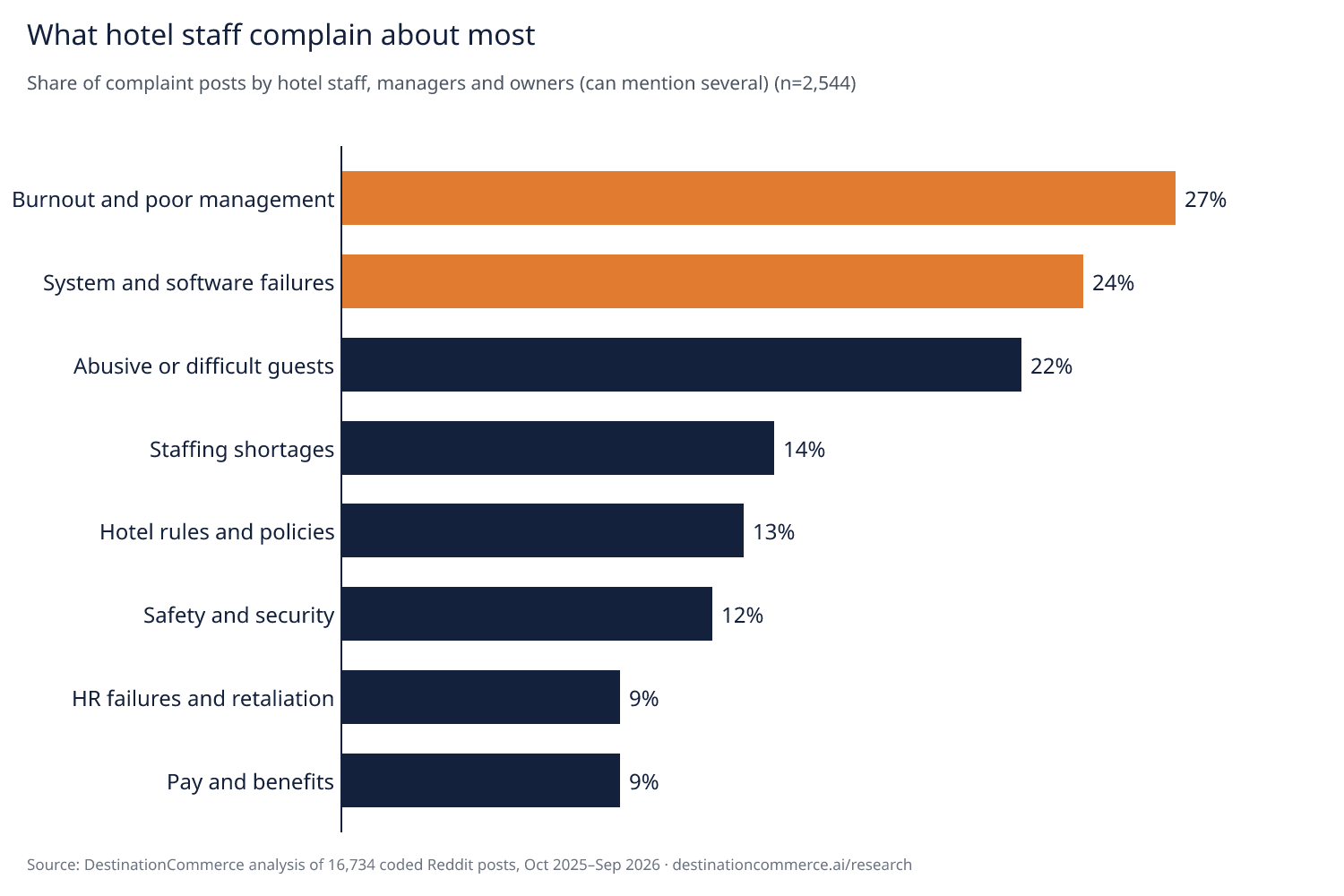
| Rank | Issue | Share of staff complaint posts |
|---|---|---|
| 1 | Burnout and poor management | 27% |
| 2 | System and software failures | 24% |
| 3 | Abusive or difficult guests | 22% |
| 4 | Staffing shortages | 14% |
| 5 | Hotel rules and policies (ID, deposits, smoking, pets, visitors) | 13% |
| 6 | Safety and security | 12% |
| 7 | HR failures and retaliation | 9% |
| 8 | Pay and benefits | 9% |
Share of 2,544 complaint posts by hotel staff, managers and owners. A post can raise more than one issue.
Burnout leads the staff list. Hotel staff also complain more often than guests: 65% of posts by staff describe a problem, against 31% of posts by guests. Part of that gap comes from one large storytelling forum for front-desk workers. Outside it, staff posts are still more likely to be complaints (40% vs 30%).
What burnout looks like:
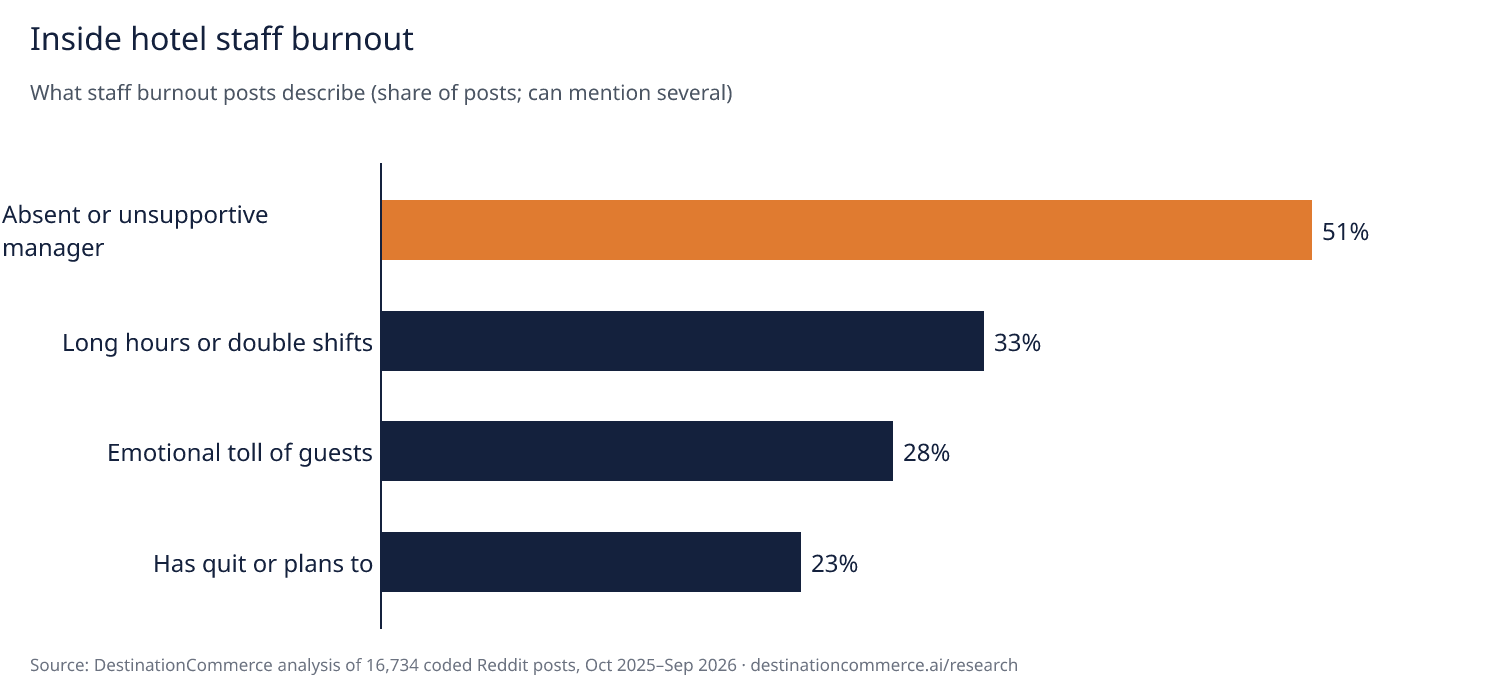
- 51% of burnout posts describe a manager who is absent, unsupportive or hostile.
- 33% describe long hours or double shifts.
- 28% describe the emotional toll of dealing with guests.
- 23% say the writer has quit or plans to.
Staffing shortages rank fourth, but the two issues are linked: 49% of posts about short staffing also describe burnout. The most common staffing complaint isn't an open vacancy (13%). It's working alone or with a skeleton crew (42%).
Finding 2: Hotel systems are the second-biggest staff headache
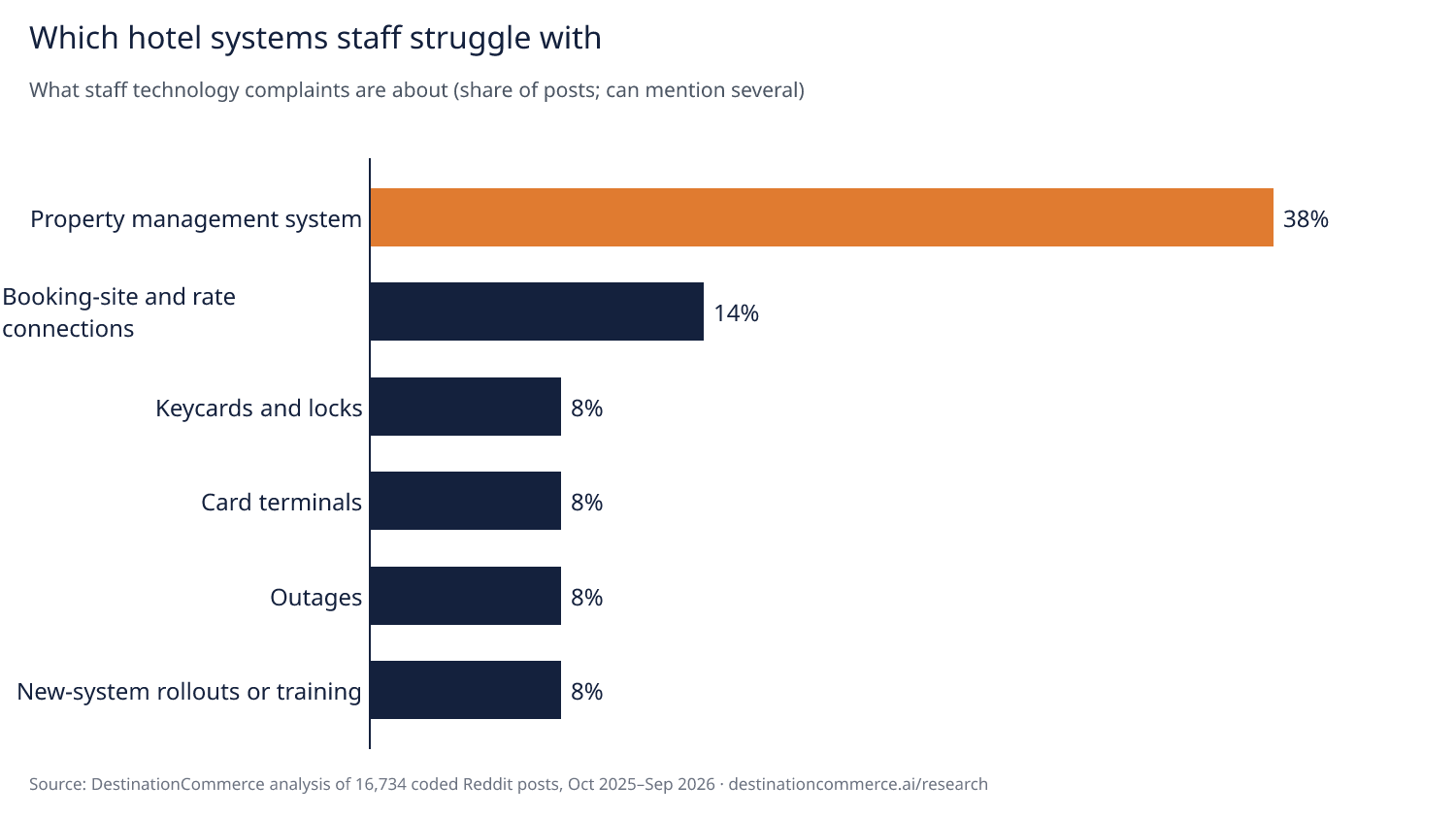
In r/askhotels, the community where hotel staff ask each other practical questions, technology is the most common problem: 35% of staff complaint posts. Across all communities it is 24%.
- 38% of staff technology posts are about the property management system itself.
- 14% are about booking-site and rate connections (the link between the hotel's system and third-party booking sites).
- 8% each are about keycards and locks, card terminals, and outages.
- 8% are about new-system rollouts or training.
When one system stops working, the front desk can't check guests in, issue keys or take payment. Staff fall back on paper and workarounds while guests wait.
Finding 3: Guests' biggest problems start before they reach the room
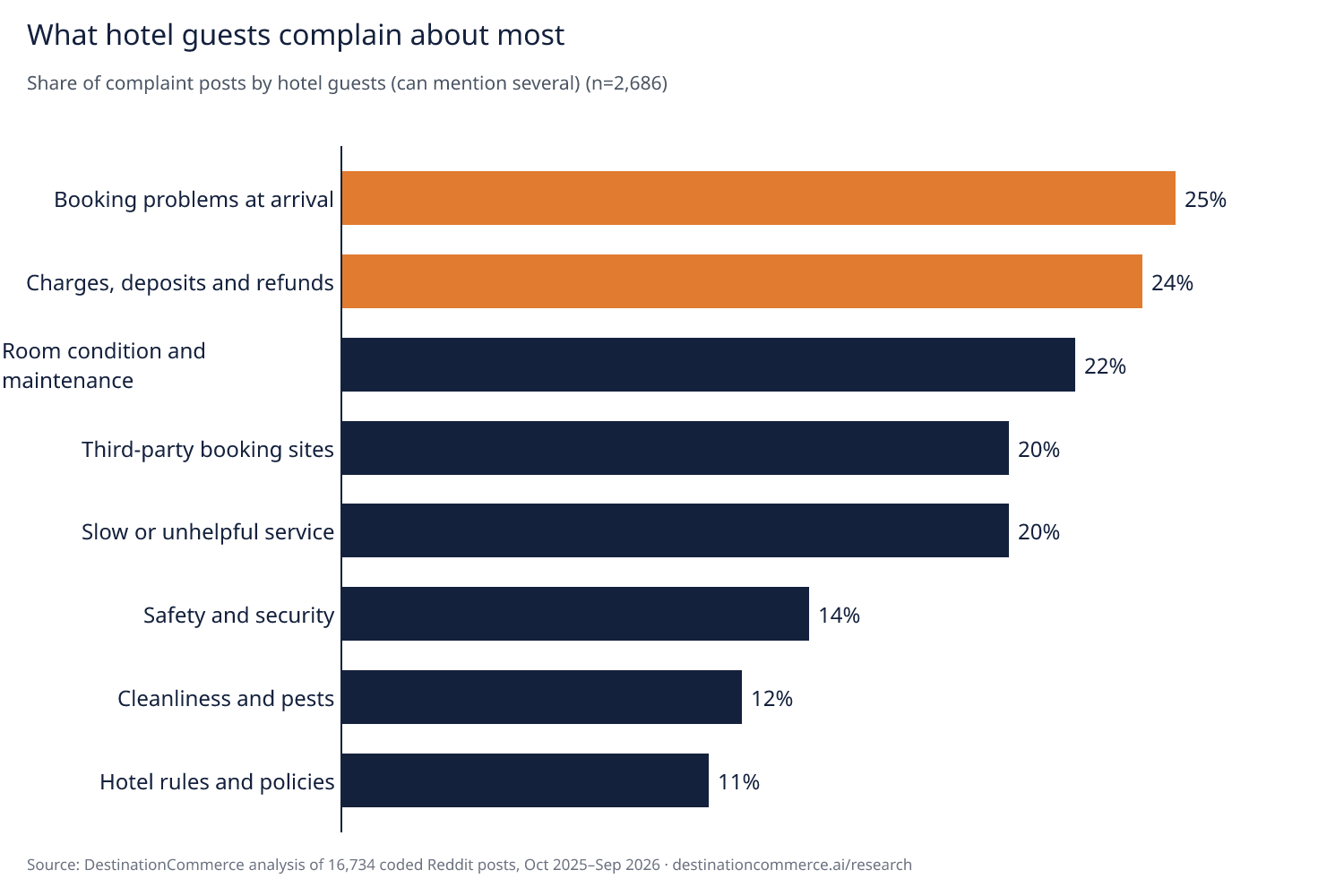
| Rank | Issue | Share of guest complaint posts |
|---|---|---|
| 1 | Booking problems at arrival | 25% |
| 2 | Charges, deposits and refunds | 24% |
| 3 | Room condition and maintenance | 22% |
| 4 | Third-party booking sites | 20% |
| 5 | Slow or unhelpful service | 20% |
| 6 | Safety and security | 14% |
| 7 | Cleanliness and pests | 12% |
| 8 | Hotel rules and policies | 11% |
Share of 2,686 complaint posts by hotel guests. A post can raise more than one issue.
Four of the top five guest problems concern what happens between booking and arrival, not the bed or the shower:
- Booking problems: cancellation or refund disputes (34%), a reservation the hotel can't find or has cancelled (21%), the room not matching what was booked (16%), and changes the hotel won't make (15%).
- Charges: refunds that haven't arrived (37%), extra charges after the stay (18%), and being charged twice or at the wrong rate (15%).
- Room condition: mostly broken fixtures or maintenance (40%), followed by rooms that look older than in the photos (20%).
Room-condition and safety posts drew the most discussion. In r/hotels and r/askhotels they received a median of 9 comments, against 5 for a typical guest post.
Finding 4: About 1 in 5 guest complaints involves a third-party booking site
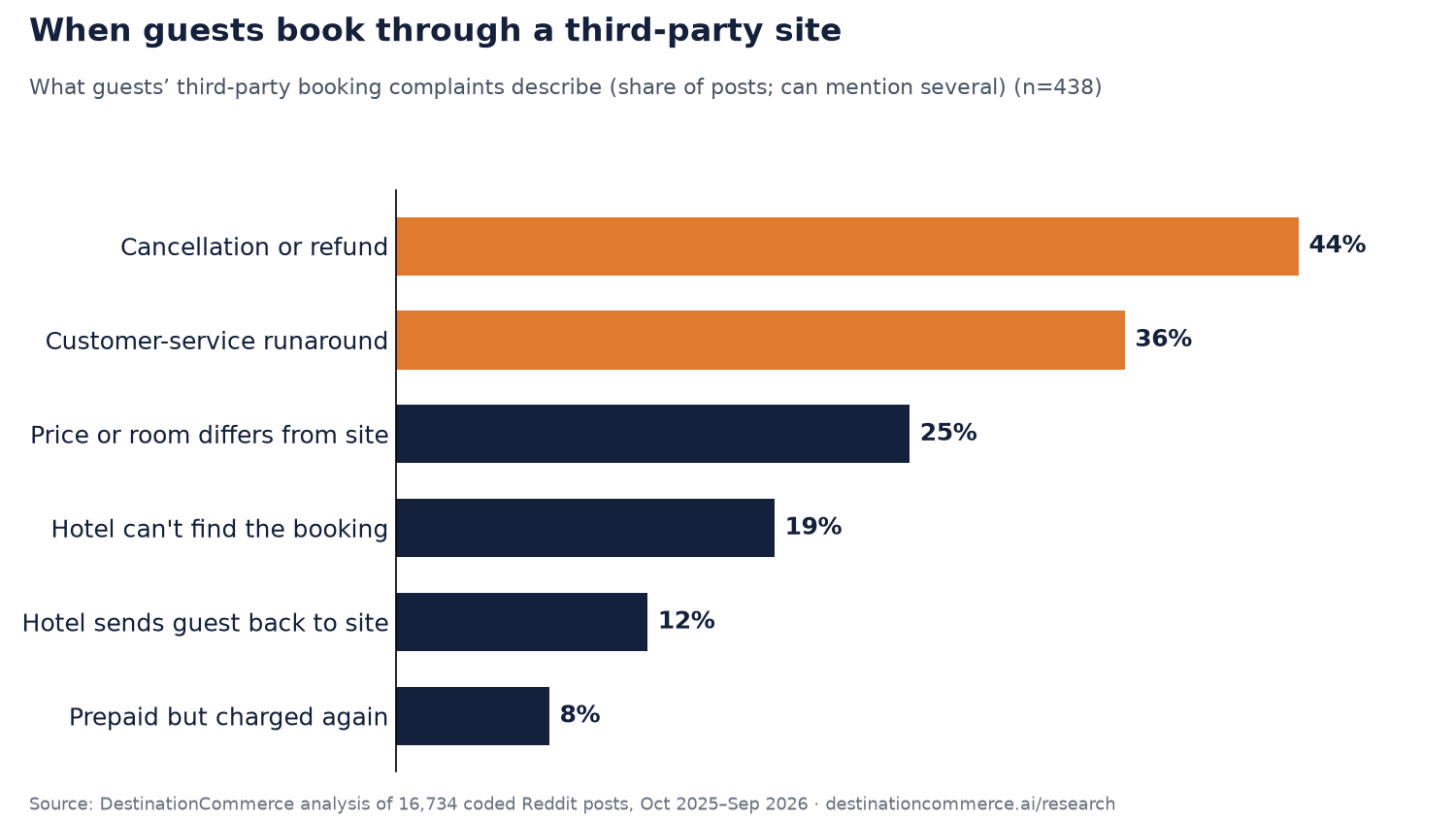
Across the communities we studied, 22% of guest complaint posts involve a booking made through a third-party site (27% outside the hotel-brand communities). Among guest complaints about booking problems, 36% involve a third-party site.
When those bookings go wrong, guests describe:
- a cancellation or refund dispute (44%);
- being passed between the booking site and the hotel (36%);
- a price or room that differs from what the site showed (25%);
- a hotel that can't find the booking (18%);
- being sent back to the site by the hotel (12%).
The pattern is the same throughout: the guest paid one company, but another delivers the stay, and it isn't clear who can fix the problem. This is a finding about where complaints land, not about how often third-party bookings go wrong overall.
Finding 5: Staff and guests describe the same problems from opposite sides
| What guests say | What staff say |
|---|---|
| Nobody answered the phone, or a request was ignored (26% and 24% of service complaints) | Working alone or with a skeleton crew (42% of staffing complaints) |
| Charged a deposit or extra fee they didn't expect | Hotel rules and policies (13% of staff complaints): enforcing deposit, ID and smoking rules |
| The hotel couldn't find their booking or room | Booking-site and rate connections (14% of technology complaints) |
| A manager or head office didn't resolve the problem (29% of service complaints) | Absent or unsupportive management (51% of burnout posts) |
These are two sides of one conversation, not a measured cause-and-effect link. But they suggest that many guest complaints start upstream, with staffing, systems and booking handovers, before anyone reaches the front desk.
Finding 6: Search shows the gap between industry and guest concerns
Searches about hotel problems are small and spread across many phrasings. U.S. monthly Google searches (Ahrefs) for "hospitality industry challenges" (100), "hotel complaints" (80) and "hotel industry issues" (30) are dwarfed by guest searches about specific moments: "resort fee" (2,000), "late check out" (900) and "hotel deposit" (350). Operators search for systems ("hotel PMS", 1,300) and pay ("hotel manager salary", 1,700).
Search volume shows the scale of interest, not how often each problem happens. But it matches the Reddit picture: guests search for answers about specific charges and rules, while staff search for tools and pay.
What hotels can do
- Measure staff capacity, not only vacancies. Track overtime, cover shifts and the number of shifts worked alone. Short staffing shows up as burnout long before it shows up as an open job.
- Back up the front line. Absent management is the most common detail in burnout posts. Clear escalation paths and on-shift support cost less than replacing staff.
- Make the booking handover reliable. Check that third-party bookings, room types and special requests reach the property management system complete. Give staff one clear rule for who fixes what.
- Explain deposits and charges three times: at booking, at check-in and in writing at check-out. Refund timelines are the most common detail in guest charge complaints.
- Plan for system failure. Keep a tested offline routine for check-in, keys and payment.
- Own more of the guest relationship. When guests book rooms, extras and local experiences directly with the hotel, the hotel controls what they're told and charged. This is a recommendation, not a finding of this study.
Methodology
Sources. We collected 31,996 public Reddit posts dated 7 October 2025 – 6 October 2026 through a public Reddit archive. They come from three hotel communities (r/askhotels, r/TalesFromTheFrontDesk, r/hotels), five hotel-brand communities, r/travel (hotel-related posts), and four general work communities (hotel-related posts from r/housekeeping, r/KitchenConfidential, r/managers and r/smallbusiness).
Sample. We coded 16,734 posts: every post from most communities, and a random 1,500 from each of the three largest brand communities. Results use the 12 full months from October 2025 to September 2026 (16,531 posts, of which 5,521 describe a problem).
Coding. An AI model coded each post using a 22-category codebook (available on request):
- who wrote it (hotel staff, owner, guest or other);
- whether it described a problem;
- up to three issues.
A second, independent AI model re-coded a random 400 posts. Agreement was κ = 0.80 on who wrote the post and κ = 0.74 on the main issue, above the 0.70 standard used in content analysis. A third pass coded the details within each top issue.
Ranking. We counted only posts that describe a problem. Each issue's share is calculated within each community group, then the groups are averaged equally, so no single large community decides the ranking. Upvotes aren't used. Comment counts are reported only as a sign of how much discussion an issue draws.
Other sources. Ahrefs U.S. Google search volumes (retrieved 7 October 2026), AHLA's Front Desk Feedback survey (246 hoteliers, February 2026), BLS JOLTS and Current Employment Statistics, and the FTC's fee rule.
Limits.
- Reddit users aren't a representative sample of hotel staff or guests, and people post when something goes wrong.
- The percentages describe complaint posts in these communities, not the hotel industry as a whole.
- Agreement was lower for three categories (booking problems, staffing, resort fees), so treat their exact shares as approximate.
- We don't report trends over time: one year of data isn't enough to separate change from seasonality.
- No hotel company is named in this report, and no posts are quoted.
Data on request. The full dataset (aggregate rankings, every figure in this report, the 22-category codebook and method notes) is available to journalists and researchers on request: hello@destinationcommerce.ai.
Cite this research: DestinationCommerce, "The Hotel Industry Issues Report 2026", October 7, 2026, https://destinationcommerce.ai/research/hotel-industry-challenges/
Media contact: Graham Beck is available for interview: hello@destinationcommerce.ai
More from this research series
FAQ
- What are the biggest problems in the hotel industry?
- From the inside: burnout and poor management (27% of staff complaint posts in our study), technology failures (24%) and difficult guests (22%). Industry surveys add the cost side: 65% of hoteliers in AHLA's February 2026 survey named labor costs as a top pressure, and more than half reported being understaffed.
- What do hotel guests complain about most?
- Booking problems at arrival (25% of guest complaint posts), charges, deposits and refunds (24%), room condition (22%), third-party booking problems (20%) and slow or unhelpful service (20%).
- Is there still a staffing shortage in hotels?
- Yes. More than half of hoteliers in AHLA's February 2026 survey said they were understaffed. U.S. accommodation employment is 9% below February 2020. On Reddit, staff describe it as working alone (42% of staffing complaints), and half of short-staffing posts also describe burnout.
- What goes wrong with third-party hotel bookings?
- In guest complaints involving a booking site, the most common problems are cancellation or refund disputes (44%), being passed between the site and the hotel (36%), and a price or room that doesn't match the site (25%).
- Can I use this data?
- Yes. Please credit DestinationCommerce and link to this page. The charts are free to embed. The full dataset (aggregate rankings, every figure in this report, the 22-category codebook and method notes) is available to journalists and researchers on request: hello@destinationcommerce.ai.