[ BEYOND THE ROOM · ORIGINAL RESEARCH ]
The Hotel Experiences Report 2026
Hotels sell the stay. Someone else sells the experience.
Original research from DestinationCommerce · Published October 2026 · By Philip Beck
Last updated
We analyzed 500+ hotels, from economy hotels to luxury resorts, in 25 destinations around the world, to answer one question: when a hotel promotes something to do, can a guest actually book it with the hotel?
Mostly, they can't. The underlying dataset and validation guide are available on request.
Key findings
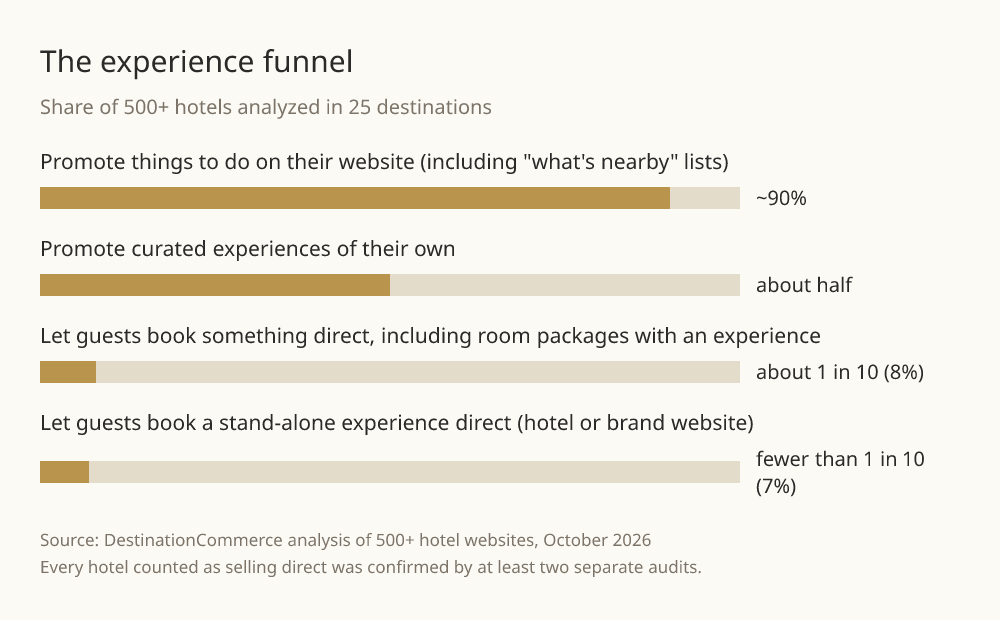
- Nearly 9 in 10 hotels promote things to do on their website, from "what's nearby" lists to tours, classes, spa rituals and events.
- About half promote curated experiences of their own: tours, classes, tastings, spa rituals, events and excursions.
- Fewer than 1 in 10 let guests book a stand-alone experience directly on the hotel's own website or a website run under the brand's own name.
- Count room packages that include an experience, and it's still only about 1 in 10.
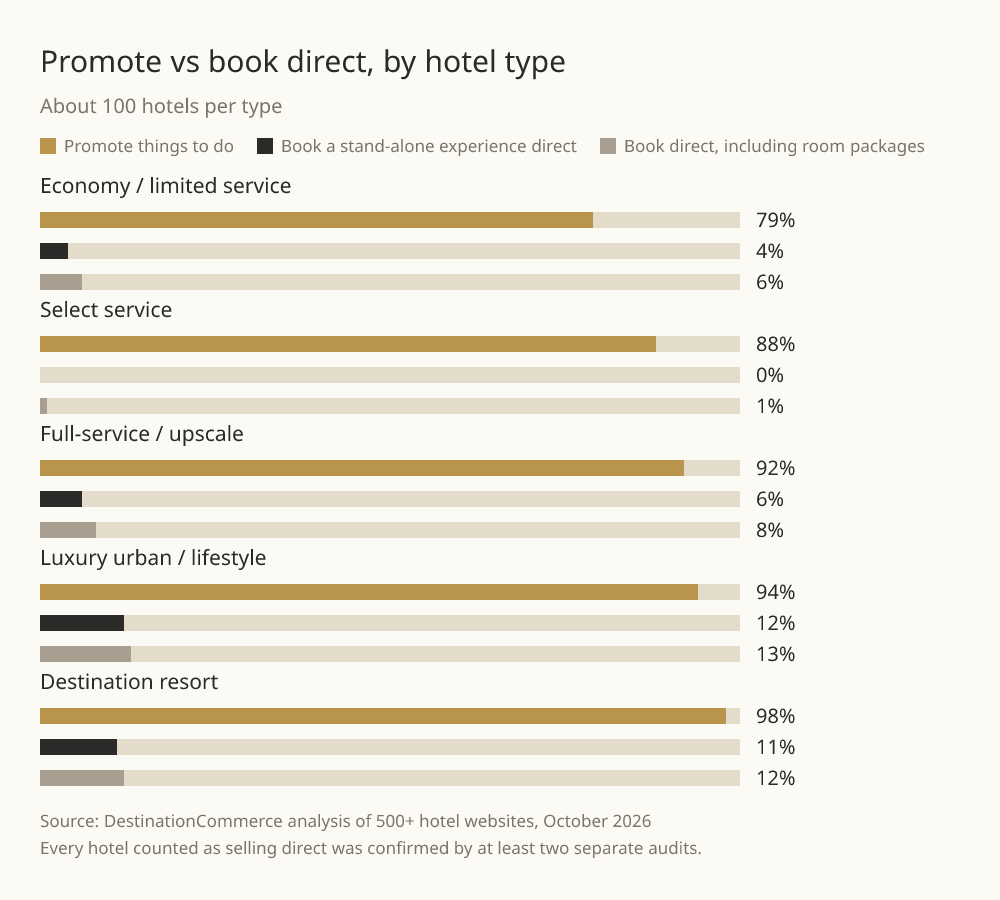
- Select-service hotels almost never sell experiences: just 1 of the 96 we checked did, and only as part of a room package.
- Luxury hotels and resorts are the most likely to sell experiences directly, but even there, nearly 9 in 10 don't.
- Only about 1 in 4 hotels publishes an events calendar.
Every hotel we count as selling direct was confirmed by at least two separate audits.
Why this matters
Travel experiences (tours, activities and attractions) are a $271 billion market, projected to reach $342 billion by 2029 (Arival and Phocuswright, 2026). And the money spent around a hotel stay is bigger than the stay itself: U.S. hotel guests spend about $106 off-property for every $100 they spend on lodging, before transportation (DestinationCommerce calculation from Oxford Economics for AHLA data, 2024).
The experiences market is also still moving online. Only 33% of experience bookings were made online in 2025, against 64% across travel as a whole (Arival and Phocuswright, 2026). Hotels have the guest, the trust and the local knowledge, and their websites already recommend the restaurant, the boat trip and the guided hike. Until now, nobody had measured whether hotels let guests buy what they recommend.
Finding 1: Hotels promote things to do. Almost none sell them.
| Finding | Share of hotels |
|---|---|
| Promote things to do on their website (including "what's nearby" lists) | ~90% |
| Promote curated experiences of their own | about half |
| Let guests book something direct, including room packages with an experience | about 1 in 10 (8%) |
| Let guests book a stand-alone experience direct (hotel or brand website) | fewer than 1 in 10 (7%) |
A guest who wants the surf lesson, the cabana or the cooking class is usually sent to another company's website, asked to call or email, or given no way to book at all.
Finding 2: The gap is widest at select-service hotels, and narrowest at luxury hotels and resorts
| Hotel type | Promote things to do | Promote curated experiences* | Book a stand-alone experience direct | Book direct, including room packages |
|---|---|---|---|---|
| Economy / limited service | 79% | ~5% | 4% | 6% |
| Select service | 88% | ~10% | 0% | 1% |
| Full-service / upscale | 92% | ~75% | 6% | 8% |
| Luxury urban / lifestyle | 94% | ~80% | 12% | 13% |
| Destination resort | 98% | ~80% | 11% | 12% |
About 100 hotels per type. *Estimated from a random re-check of 10 hotels per type; read as approximate.
Economy and select-service hotels almost all list "what's nearby" (museums, stadiums, shopping districts), but very few curate experiences of their own, and there's almost never anything to buy.
Full-service hotels mostly curate experiences but rarely sell them. When they do sell direct, it's often as a room package: a "Spa Escape" rate or a stay with a tour included.
Luxury hotels and resorts are the most likely to sell the experience itself (surf lessons, cabanas, spa days, afternoon tea), often through the brand's own booking website. Even there, nearly 9 in 10 don't.
Finding 3: When hotels don't take the booking, someone else does
When a hotel does point guests to a way to book, it's usually another company's website: restaurant booking platforms such as OpenTable and SevenRooms, spa booking tools such as SpaTime, ticketing sites such as Eventbrite, pool and cabana booking tools such as iPoolside, and tour marketplaces such as GetYourGuide and Viator. Many other experiences end in a phone call, an enquiry form, or no booking route at all.
Some of these are good tools that hotels choose on purpose. But together, they mean a guest may be sent to several different websites to book several things, and the hotel never sees the whole trip in one place. Even when the page carries the hotel's name, the guest is often paying on another company's website.
Finding 4: Chains are only slightly ahead of independents
You might expect big brands, with big technology budgets, to be far ahead. They aren't. 9% of chain hotels and 6% of independents let guests book an experience direct (including room packages), a gap within the margin of error.
The chains that do best run their own experiences or booking websites. Hyatt's experiences site, for example, lets guests at many participating hotels book spa days, cabanas and local experiences with a date, a price and a cart. The independents that do best sell through their own booking engine or online shop.
Finding 5: Only about 1 in 4 hotels publishes an events calendar
Hotels host wine tastings, live music, holiday brunches and kids' programmes, but only about 1 in 4 publish a calendar of upcoming events for guests or the public. Resorts are the most likely to; economy and select-service hotels rarely do.
Best in class: hotels where you can book it direct
These hotels let a guest pick a date, see a price and reach checkout for an experience on the hotel's or brand's own website. Each was confirmed by at least two separate audits in October 2026.
- Pendry San Diego: rooftop cabanas and daybeds, booked on the hotel's own site
- Shutters on the Beach, Santa Monica: surf lessons with a date picker on the hotel's own site
- Park Hyatt New York: experiences on Hyatt's own experiences site
- The Connaught, London: afternoon tea, booked on the hotel's own site
- Brown's Hotel, London (Rocco Forte Hotels): seasonal experiences on the brand's site
- Royal Lahaina Resort, Maui (independent): poolside cabanas and more on its own experiences page
- The National Hotel, Miami Beach (independent): pool day passes and classes in its own online store
- Palazzo Versace Dubai: spa and dining experiences in its own experience store
- Travelodge (UK): theatre and attraction tickets on the brand's own experiences site, a rare example from the economy tier
They prove this isn't about size or budget. Independents and global brands, luxury and economy alike, can turn "things to do" into things to buy.
What hotels can do
- Make every experience you promote bookable. If it's on your website, give it a date, a price and a "Book" button.
- Sell the experience, not just the package. Many guests want the cabana or the cooking class on its own.
- Turn recommendations into products. The guides, operators and venues your concierge already recommends can become bookable partners on your site.
- Bring the booking home. Keep specialist tools where they work, but give guests one place to buy everything around their stay.
- Publish your events. A calendar with tickets turns "what's on" into revenue.
That's what we mean by destination commerce: the hotel's website as the place where guests book the whole stay, not just the room.
Frequently asked questions
- Do hotels offer experiences?
- Most promote something. In our analysis of 500+ hotels, nearly 9 in 10 promoted things to do on their website, and about half promoted curated experiences of their own, such as tours, classes, spa rituals or events.
- Can you book hotel experiences on the hotel's website?
- Usually not. Fewer than 1 in 10 of the 500+ hotels we analyzed let guests book a stand-alone experience directly on the hotel's or brand's own website. Most send guests to other companies' websites, ask them to call or email, or offer no way to book.
- Which hotels are most likely to sell experiences directly?
- Luxury hotels and destination resorts, at roughly 1 in 9. Full-service hotels rarely sell their experiences, and select-service hotels almost never do.
- Where do hotel guests book experiences instead?
- On other companies' websites: restaurant booking platforms, spa booking tools, ticketing sites, cabana booking tools and tour marketplaces. Otherwise, by calling or emailing the hotel.
- Do independent hotels sell experiences better than chains?
- Not by much. In our analysis, 9% of chain hotels and 6% of independents let guests book an experience directly.
Methodology
Sample. 502 hotel website audits (497 unique hotels), carried out in October 2026: about 100 each of economy / limited service, select service, full-service / upscale, luxury urban / lifestyle and destination resort hotels, with quotas for chain and independent hotels. The hotels are in 25 destinations: 15 in the United States (New York, Chicago, Miami, Miami Beach, Orlando, Nashville, New Orleans, San Diego, Las Vegas, Dallas, Washington DC, Los Angeles, Maui, Scottsdale and Palm Springs) and 10 international (London, Paris, Rome, Dubai, Tokyo, Singapore, Cancún, Bali, Phuket and the Amalfi Coast). Within each destination and hotel type we selected well-known, currently operating hotels with an official website. The results describe these hotels; they aren't a statistical estimate for every hotel worldwide. U.S. and international results were in line with each other.
What we checked. Each hotel's official website, browsing only (no bookings or form submissions): whether it promotes things to do, whether those include curated experiences of its own, whether it publishes an events calendar, and how a guest can buy up to five featured experiences.
Definitions.
- Experience: anything a hotel promotes for guests to do beyond the room and basic amenities: tours, classes, tastings, spa treatments, wellness sessions, cabanas and day passes, events, kids' programmes.
- Curated experience: an experience the hotel itself offers, hosts or packages, as opposed to a generic list of nearby attractions.
- Book direct (stand-alone): a guest can choose a date, see a price and reach checkout for an experience on the hotel's own website or booking engine, or on a website run under the hotel brand's own name and web address (for example Hyatt's experiences site). An enquiry form without a price or checkout doesn't count.
- Book direct, including room packages: adds room packages that bundle an experience.
- Third party: any booking website run by a company the hotel isn't affiliated with: marketplaces, ticketing sites and booking-software tools, even when the page carries the hotel's name.
Verification. Two further independent audits re-checked 216 hotels from scratch, blind to the earlier answers: every hotel found selling direct, random samples of hotels found not selling direct in every hotel type, samples of hotels found promoting nothing, and every site that couldn't be loaded. We publish the most recent re-checked result wherever one exists. In the final re-check, 2 of 50 randomly chosen "not direct" hotels turned out to sell direct, so the true shares may be slightly higher than reported (our adjusted estimate: about 8% stand-alone, 10% including packages; both still under or at "1 in 10").
Exclusions and limits. 9 hotels whose sites couldn't be verified are excluded from booking figures, and hotels audited under two hotel types are counted once. Websites change; these results reflect October 2026. Margins of error are about ±3 points overall and about ±7 points per hotel type.
Data and validation. The dataset, the full hotel list and our validation guide are available on request. Hotels are not named in the results file, except those that sell experiences directly.
Cite this report: DestinationCommerce (DropDesk), The Hotel Experiences Report 2026, 2027. https://destinationcommerce.ai/research/hotel-experiences/
Free to use. Cite any figure with a link to this page. Media contact: hello@destinationcommerce.ai · Philip Beck is available for interview.
Sources: experiences market size and online share, Arival and Phocuswright, The Outlook for Travel Experiences 2019–2029 (February 2026). $106 per $100: DestinationCommerce calculation from Oxford Economics for AHLA data, 2024.
Related research: The Hotel Day Pass Report · Experiential Travel Statistics 2026 · Hotel Direct Booking Statistics 2026 · Selling local experiences