[ BEYOND THE ROOM · ORIGINAL RESEARCH ]
The Hotel Day Pass Report 2026
Who sells access to America's hotel pools? Mostly, not the hotels.
Original research from DestinationCommerce · Published October 2026 · By Philip Beck
Last updated
Hotel day passes have gone mainstream. "Resort pass" is searched about 67,000 times a month in the U.S. (Ahrefs, October 2026), and 2,062 U.S. hotels list pool, cabana, spa or day-room access on ResortPass's U.S. city pages (our count, 1 October 2026).
So we asked a simple question: when someone who isn't staying overnight wants to use a hotel's pool, can they buy that access from the hotel?
We drew a random sample from those 2,062 hotels and checked the official websites of 280 hotels in 39 states, recording exactly how a non-guest can buy day access. The underlying dataset and validation guide are available on request.
Key findings
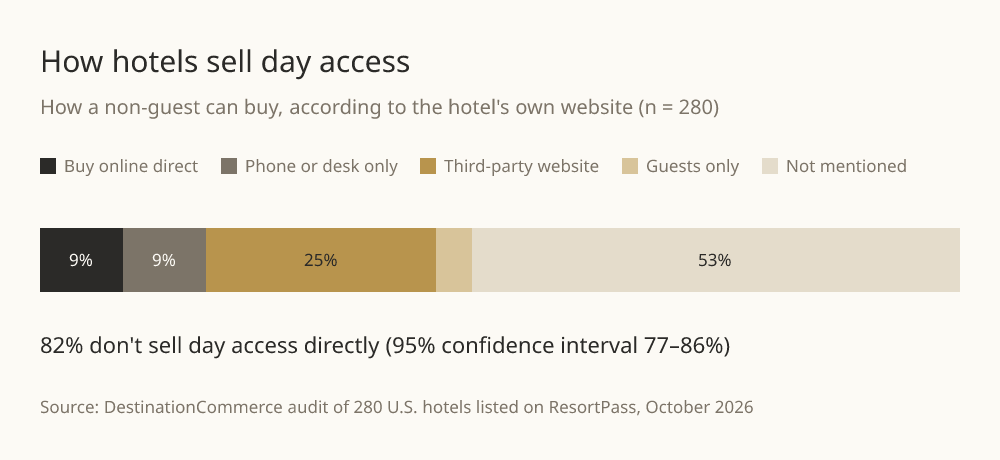
- More than 4 in 5 hotels (82%) that sell day access through platforms like ResortPass don't sell it on their own website. They send buyers to a third-party booking site, don't mention day access at all, or say the pool is for guests only.
- Fewer than 1 in 10 let a non-guest pick a date and pay online on the hotel's own website or its brand's booking site.
- More than half (53%) don't mention day access anywhere on their own website.
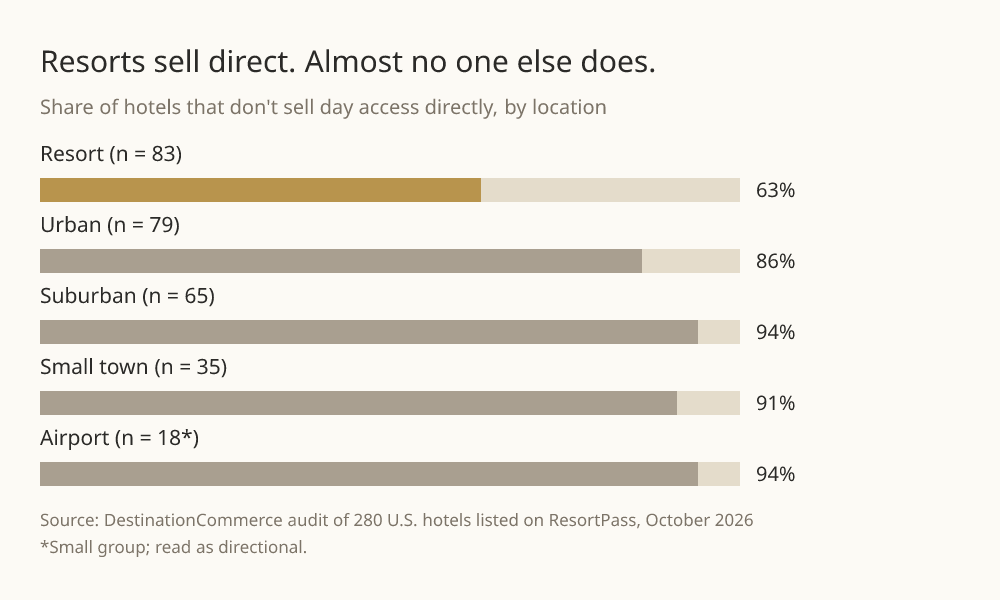
- Resorts are the exception: about 1 in 5 resorts sell day access online themselves, against fewer than 1 in 20 other hotels.
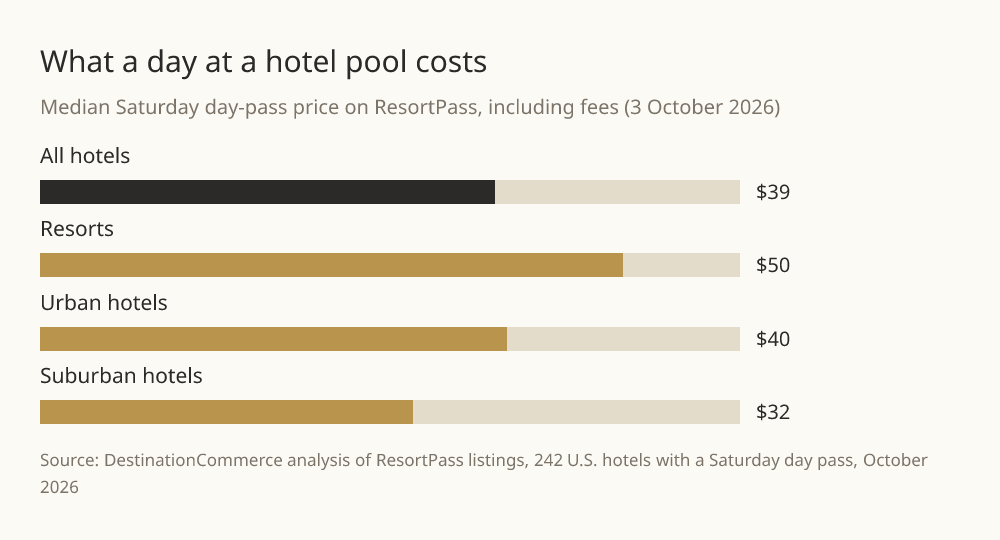
- A Saturday day pass costs a median $39 on ResortPass, and a cabana $250.
- In Southern California, where we checked every listed hotel, nearly 3 in 4 (73%) don't sell day access on their own website.
Why this matters
Day access has become a real product. ResortPass says it works with 2,700+ hotel and spa partners (ResortPass, June 2026), and in 2026 it announced an agreement with Marriott International (May) and an expanded partnership with Hilton (July). For a hotel, a day guest uses a pool, cabana or spa that is already staffed, and often spends on food, drinks and treatments too.
But a buyer's journey usually starts with a search, not with the hotel. Our question was what happens when that buyer goes to the hotel's own website instead.
Finding 1: More than 4 in 5 hotels don't sell day access on their own website
| How a non-guest can buy day access, according to the hotel's own website | Share of hotels (n = 280) |
|---|---|
| Buy online on the hotel's or brand's own website | 9% |
| Buy by phone, email or at the front desk only | 9% |
| Sent to a third-party booking website | 25% |
| Told the amenity is for registered guests only | 4% |
| Day access not mentioned at all | 53% |
| Don't sell directly (last three rows) | 82% (95% confidence interval 77–86%) |
The biggest group isn't hotels that hand buyers to a platform. It's hotels that say nothing at all. Their pool is for sale, just not on their own website.
Many hotels that do link out send buyers to a page with the hotel's name on it, hosted by another company: a hotel-branded ResortPass page (hotel.resortpass.co) or a cabana and spa booking tool such as iPoolside or SpaTime. These look like the hotel's own pages, but the booking happens on another company's website, so we count them as third party.
Finding 2: Resorts sell direct. Almost no one else does.
| Hotel location | Hotels | Don't sell directly | Day access not mentioned on own site |
|---|---|---|---|
| Resort | 83 | 63% | 18% |
| Urban | 79 | 86% | 54% |
| Suburban | 65 | 94% | 78% |
| Small town | 35 | 91% | 71% |
| Airport | 18* | 94% | 83% |
*Small group; read as directional.
Resorts have the most to sell (big pools, cabanas, beach clubs and spas) and many already run them as businesses. City, suburban and airport hotels sell day passes too, but almost none of them say so on their own site.
Finding 3: The higher the hotel class, the more likely it sells direct
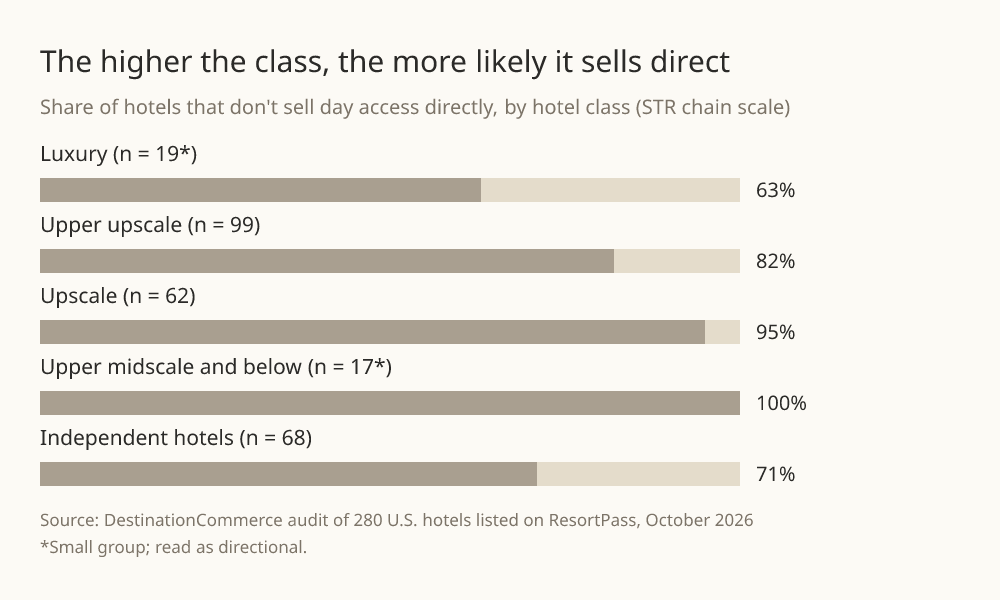
| Hotel class (STR chain scale) | Hotels | Don't sell directly |
|---|---|---|
| Luxury | 19* | 63% |
| Upper upscale | 99 | 82% |
| Upscale | 62 | 95% |
| Upper midscale and below | 17* | 100% |
| Independent hotels | 68 | 71% |
*Small group; read as directional.
Below upper upscale, day access is sold almost entirely through third parties, or not mentioned at all. Where upper-tier hotels do sell online, it's often through a brand-run booking website, such as Marriott's day-pass site.
Independent hotels are more likely than chains to sell by phone or at the front desk. To check the independent result, we audited a second, separate random sample of 49 independent hotels: 84% of them don't sell day access directly, in line with the main sample.
Finding 4: What a day at a hotel pool costs
Median Saturday prices listed on ResortPass, including fees, for Saturday 3 October 2026:
| Day pass | Cabana | |
|---|---|---|
| All hotels | $39 (242 hotels) | $250 (93 hotels) |
| Resorts | $50 | $300 |
| Urban hotels | $40 | $259 |
| Suburban hotels | $32 | $224 |
| California | $50 | $308 |
| Florida | $40 | $250 |
| Texas | $30 | $225 |
Half of day passes cost between $28 and $56.
Finding 5: Some hotels send mixed messages
On 9 hotel websites in our main sample (3%), the hotel says its pool or cabanas are for registered guests only, while day access to that same amenity is on sale through a booking platform. We re-checked every case on a second date, and only counted it where the restriction and the product clearly covered the same amenity.
Southern California edition
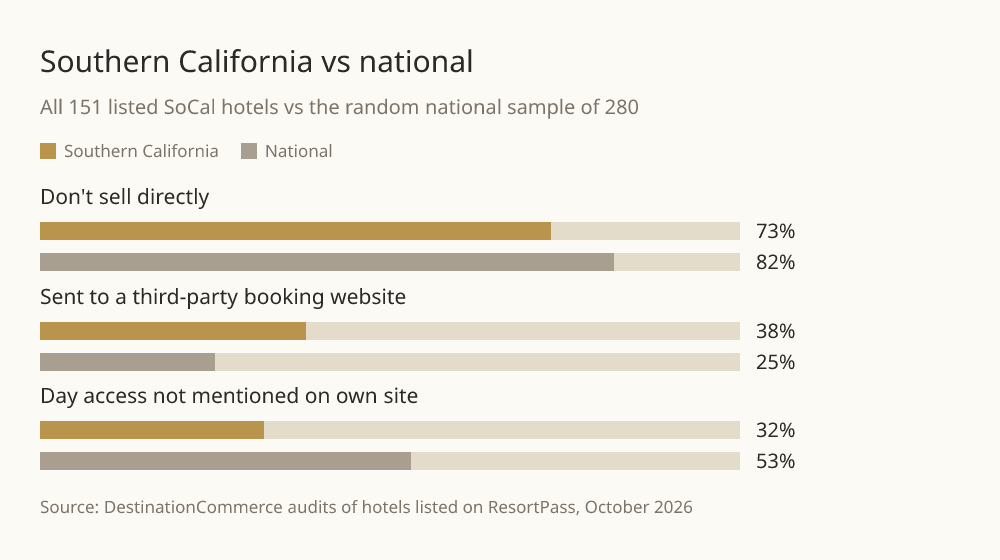
We also checked every hotel listed on ResortPass across 12 Southern California cities: 151 hotels.
| Southern California (all 151 listed hotels) | National (random 280) | |
|---|---|---|
| Don't sell directly | 73% | 82% |
| Sent to a third-party booking website | 38% | 25% |
| Day access not mentioned on own site | 32% | 53% |
| Median Saturday day pass (ResortPass) | $56 | $39 |
| Median Saturday cabana (ResortPass) | $336 | $250 |
Southern California hotels sell direct more often than the national average, largely because of the region's large resorts.
What hotels can do
- Say it on your own site. If you sell day access anywhere, put it on your website, linked from your pool and spa pages.
- Let people buy without calling. A date, a price and a checkout.
- Keep platforms for discovery, not as the only door.
- Price by demand. Weekday and weekend, cabana and lounger. Day access is inventory.
- Keep your messages consistent. If day guests are welcome, make sure your FAQ doesn't say "guests only".
That's what we mean by destination commerce: a hotel selling everything around the stay, from the room to the pool to the spa, on its own terms.
Frequently asked questions
- How much is a hotel day pass?
- A median of $39 on a Saturday for U.S. hotels listed on ResortPass, including fees (3 October 2026, 242 hotels). Resorts cost more (median $50). Half of day passes cost between $28 and $56.
- How much does it cost to rent a hotel cabana for the day?
- A median of $250 on a Saturday across U.S. hotels listed on ResortPass (93 hotels), and $300 at resorts.
- Can you use a hotel pool without staying there?
- Yes, at many hotels: 2,062 U.S. hotels list day access on ResortPass. But most don't sell it on their own website: 82% of the hotels we checked send you elsewhere, don't mention it, or say the pool is for guests only.
- Do hotels sell day passes directly?
- Fewer than 1 in 10 of the hotels we checked let a non-guest buy online on the hotel's or brand's own website. Resorts are the most likely to.
- Which hotels are least likely to sell day passes directly?
- Suburban, small-town and airport hotels, and hotels below the upscale class: more than 9 in 10 of them don't.
Methodology
Sample. We collected every hotel listed on ResortPass's U.S. city pages on 1 October 2026: 2,062 hotels and resorts in 40 states (38 non-hotel venues set aside). We drew a random sample of 303, spread across states in proportion to the listings, and shuffled it before numbering. After removing 21 venues that turned out not to be hotels, and 2 hotels whose websites couldn't be loaded, 280 hotels in 39 states remain. The results describe hotels that sell day access through platforms like ResortPass, not all U.S. hotels. These hotels skew upscale and branded, so we report results by hotel class and location. A second random sample of 49 independent hotels from the same list is used only for the independent-hotel check. The Southern California edition covers every hotel on ResortPass's 12 Southern California city pages (151 hotels).
What we checked. Each hotel's official website, in a real browser, on 1–3 October 2026, with screenshots: pool, spa, cabana, FAQ and "day pass" pages, plus a site search. One category per hotel:
- Sells online: a non-guest can pick a date, see a price and pay on the hotel's own website or booking engine, or on a website run under the hotel brand's own name and web address (for example Marriott's day-pass site).
- Phone or desk only: the site says day access is sold, with no online checkout.
- Third party: the site sends buyers to a website run by a company the hotel isn't affiliated with: booking marketplaces (including hotel-branded pages such as
hotel.resortpass.co) and booking-software tools (such as iPoolside, SpaTime, Book4Time or FareHarbor), even when the page carries the hotel's name. - Guests only: the site explicitly says the amenity is for registered guests only.
- Not mentioned: nothing found after two separate passes.
Where a hotel has several channels, the most direct counts. Prices are Saturday 3 October 2026 prices as displayed on ResortPass. No bookings were made.
Quality checks. Every "not mentioned" hotel was checked twice. A blind re-check of 38 random hotels moved none of them between "sells directly" and "doesn't". A further independent re-check of hotels in every category confirmed 9 in 10 or more of the "doesn't sell directly" classifications. Online selling was the least stable measure: some booking pages found in early October had disappeared or stopped loading when re-checked later. That's why we report it as "fewer than 1 in 10" rather than a precise figure.
Limits. One point in time; websites and listings change. Margin of error about ±5 points on the headline, wider for small groups (marked).
Data and validation. The dataset, the full hotel list and our validation guide are available on request. Hotels are not named in the results file, except those that sell day access online themselves.
Cite this report: DestinationCommerce (DropDesk), The Hotel Day Pass Report 2026, October 2026. https://destinationcommerce.ai/research/hotel-day-passes/
Free to use. Cite any figure with a link to this page. Media contact: hello@destinationcommerce.ai · Philip Beck is available for interview.
Sources: search volume, Ahrefs Keywords Explorer (U.S., October 2026). ResortPass partner count: ResortPass press release, 25 June 2026. Marriott agreement: ResortPass press release, 27 May 2026. Hilton expansion: Hilton press release, July 2026.
Related research: The Hotel Experiences Report · Hotel Direct Booking Statistics 2026 · Experiential Travel Statistics 2026