[ BEYOND THE ROOM · ORIGINAL RESEARCH ]
The Hotel Discovery Report 2026
Travelers plan around experiences. AI and search are sending them everywhere except the hotel.
Original research from DestinationCommerce · Published October 6, 2026 · By Graham Beck
Last updated
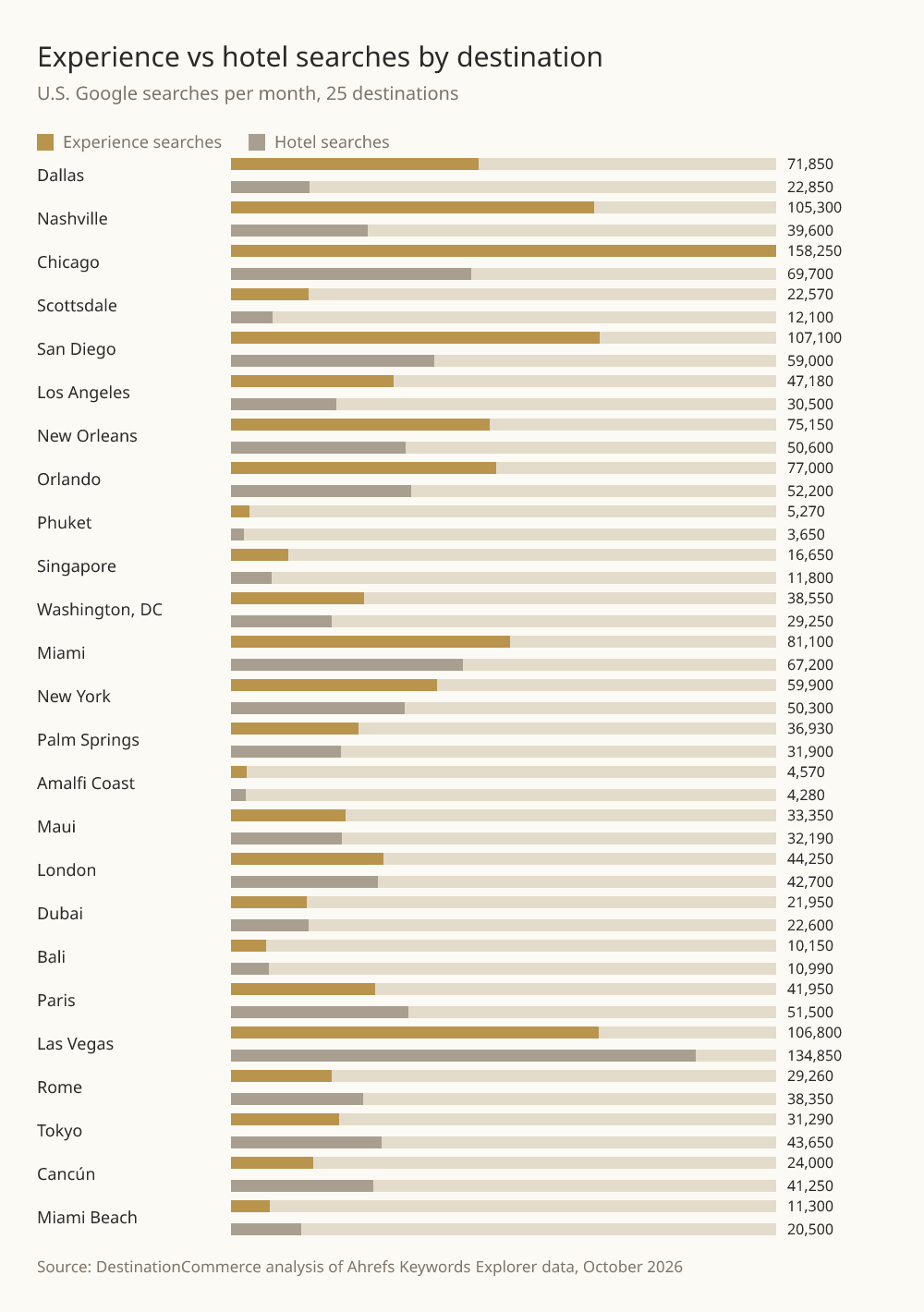
When travelers plan a trip, they start with what they'll do. In the 25 destinations we studied, Americans search for things to do 1.3 times as often as for hotels. Even when they search for a hotel by name, they're more likely to be looking up its restaurant, pool or spa than its rooms.
Those questions are now answered by Google and, increasingly, by AI assistants such as ChatGPT, Perplexity and Gemini. So we asked: when travelers look for experiences, do they find hotels? And when AI assistants look at hotel websites, can they find anything to recommend, price or book?
We analyzed 400 search terms across 25 destinations, the search traffic of 94 hotel websites, 525 answers from three AI assistants, and the AI readiness of 261 hotel websites across five hotel types. The underlying data pack is available on request, and the findings were re-checked by an independent second auditor before publication.
Key findings
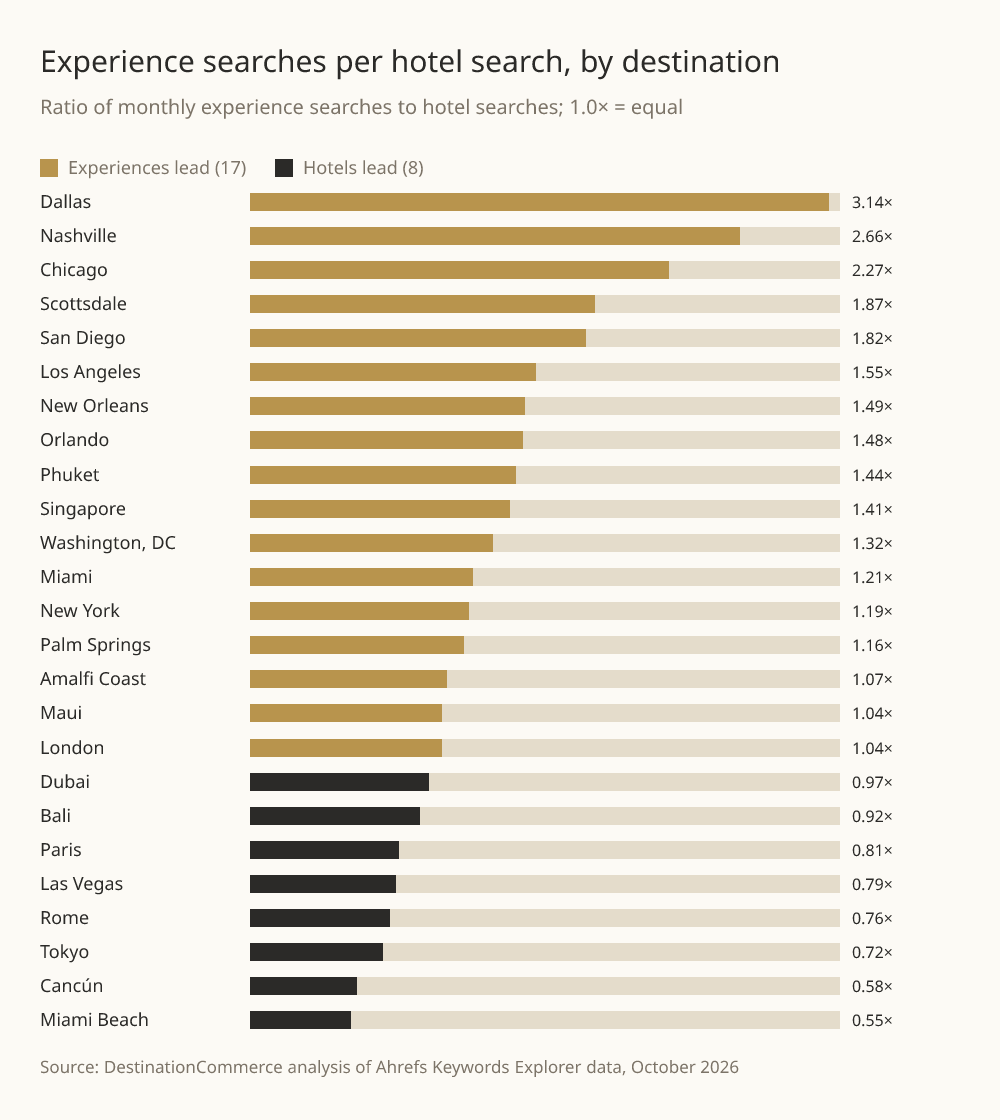
- Travelers search for things to do 1.3× as often as for hotels. That's 1.26 million monthly searches for experiences against 970,000 for hotels across 25 destinations, and experience searches lead in 17 of them.
- When people search a hotel by name, experience searches outnumber room searches by 1.7 to 1. Restaurants, pools, spas and events come up more often than rooms and rates, at 51 of 65 hotels.
- Hotels are missing where those searches land. None of the top 10 Google results for "things to do" in 15 U.S. cities is a hotel website, and hotel websites supply just 5% of the sources AI assistants cite when answering experience questions.
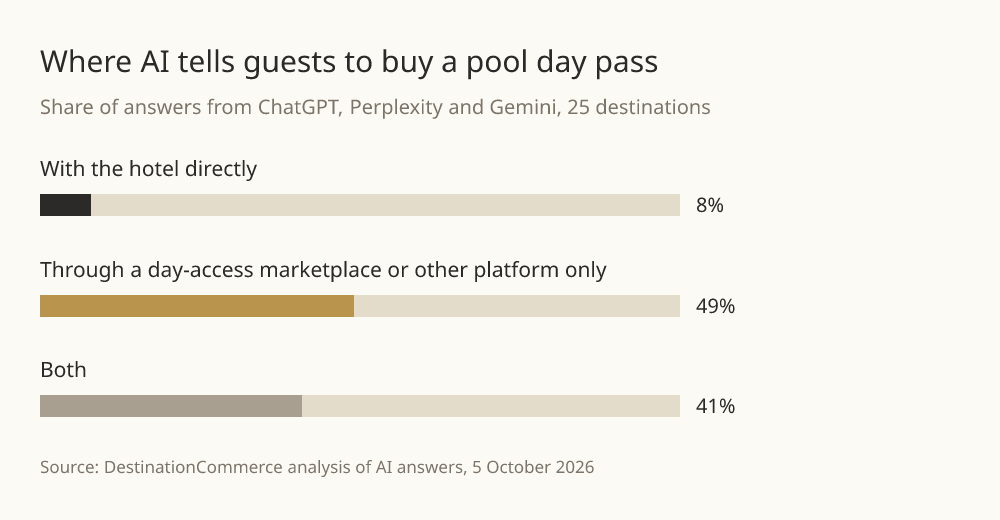
- AI recommends hotel day passes, then sends guests elsewhere to buy them. Asked where to get a pool day pass, AI assistants named a hotel in 92% of answers, but fewer than 1 in 10 (8%) told the guest to book with the hotel directly.
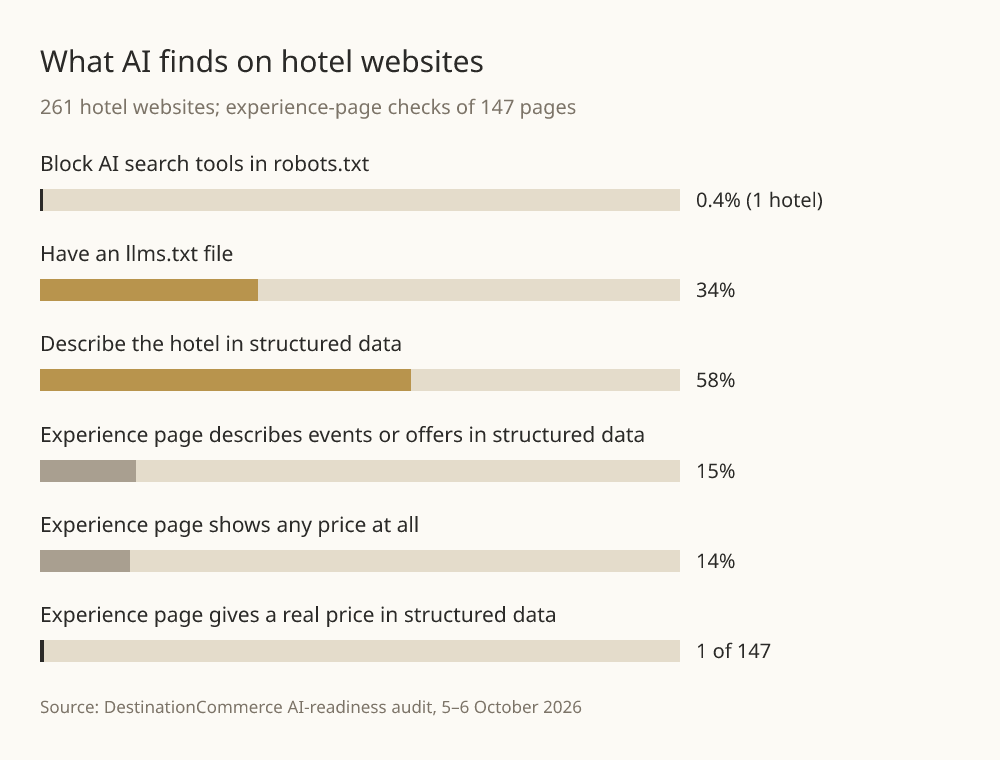
- Hotels have opened the door to AI, but there's little to buy on the other side. Only 1 of the 261 hotel websites we checked blocks AI search tools, and a third (34%) have an llms.txt file. Yet only 1 of 147 experience pages gives AI a price in a form it can reliably read, and only 14% show a price at all.
- The gap is the same for every kind of hotel. Resorts, which typically have the most to sell, show a price on just 8% of their experience pages, and big-brand hotel pages are the least likely to have an llms.txt (14%).
- Hotels that market experiences reach more new guests. Hotels in the top quarter for experience-page traffic get 24% of their search visits from people who weren't searching for them by name, against 4% for the bottom quarter.
Why this matters
AI assistants are becoming a front door for travel planning. More than half of UK travelers (52%) now use AI to help plan trips (MMGY Travel Intelligence, 2026), and 40% of travelers use AI to build itineraries (Expedia Group, 2026).
For hotels, the question is no longer only "do we rank for our name?" It's whether the hotel appears when a traveler asks what to do, and whether an AI assistant can tell that traveler what the hotel offers, what it costs, and how to book it. Guests spend about $106 off-property for every $100 they spend on lodging, before transportation (DestinationCommerce calculation from Oxford Economics for AHLA data, 2024). Most of that spending happens at businesses the hotel never sees.
Finding 1: Travelers search for experiences more than for hotels
| Experience searches / month | Hotel searches / month | Ratio | |
|---|---|---|---|
| 25 destinations | 1,261,670 | 973,510 | 1.3× |
U.S. Google searches per month, Ahrefs Keywords Explorer, October 2026. 10 experience phrasings (e.g. "things to do in [city]", "[city] restaurants", "[city] events") and 6 hotel phrasings (e.g. "hotels in [city]", "[city] resorts") per destination.
Where experiences lead most: Dallas (3.1×), Nashville (2.7×), Chicago (2.3×), Scottsdale (1.9×), San Diego (1.8×).
Where hotels lead: Las Vegas, Paris, Rome, Tokyo, Cancún and Miami Beach. These are places where the hotel is part of the trip, from casino resorts to all-inclusives.
The single biggest phrase is "things to do in [city]", with 622,200 searches a month across the 25 destinations.
Finding 2: Searches for a hotel's name are often about experiences
We collected every Google search containing the name of 65 hotels in our sample, and sorted them by topic.
| What people searched for alongside a hotel's name | Searches / month |
|---|---|
| Experiences: dining and bars, pool and day passes, spa, events, activities | 33,520 |
| Rooms, rates, deals and booking | 19,550 |
That's 1.7 experience searches for every room search, and experience searches lead at 51 of 65 hotels (78%). Typical searches look like "[hotel] restaurant menu", "[hotel] pool", "[hotel] spa" and "[hotel] christmas".
Finding 3: Hotels are almost invisible where experience searches land
On Google: we looked at the top 10 organic results for "things to do in [city]" in 15 major U.S. cities. None of the 117 results was a hotel website. About three-quarters were blogs and independent guides; the rest were travel media and booking sites (12%) and tourism boards (11%).
On hotel websites: across 78 hotel websites with meaningful search traffic, local experience searches (restaurants, spa, brunch, events, things to do and more in the hotel's own city) add up to a median of 132,000 searches a month. The median hotel gets about 3 visits a month from them, and 35 of the 78 don't appear on Google's first page for any of them.
Across all 94 hotel websites: the median hotel gets 12% of its search visits through experience pages (spa, dining, events, activities). More than 4 in 10 (44%) get less than 10%.
Finding 4: AI assistants rarely send travelers to hotels for experiences
We asked ChatGPT, Perplexity and Gemini (each with live web search) seven questions about each of the 25 destinations, making 525 answers.
| Question | Answers recommending at least one hotel or hotel venue |
|---|---|
| "What are the best things to do in [city] this weekend?" | 15% |
| "What are the best brunch spots in [city]?" | 49% |
| "What are some romantic experiences or date ideas in [city]?" | 48% |
| "Where can I get a great spa day in [city]?" | 100% |
| "Where can I get a pool day pass in [city], and how do I book it?" | 92% |
Whose websites AI cites:
| Question type | Hotel websites | Booking sites and platforms | Blogs and guides | Media and social | Tourism boards |
|---|---|---|---|---|---|
| Experiences (3,549 citations) | 5% | 17% | 51% | 16% | 12% |
| Day passes (898) | 6% | 41% | 41% | 5% | 6% |
| Hotels (1,938) | 22% | 26% | 35% | 14% | 3% |
Even when the question is about which hotel to book, about 4 in 5 citations point to a website other than a hotel's.
Where AI tells guests to buy a day pass: with the hotel directly in 8% of answers; through a day-access marketplace or other platform only in 49%; both in 41%. ResortPass was the most-named platform (49 of 75 answers).
Finding 5: Hotel websites let AI in, but give it little to sell
We visited 261 hotel websites and checked what an AI system finds when it arrives: whether it's allowed in, whether the site describes itself in structured data, whether content is readable without running JavaScript, whether there's an llms.txt guide for AI, and whether experience pages show what's for sale and at what price.
| Check (261 hotels) | Result |
|---|---|
| Block AI search tools (ChatGPT search, Perplexity, Claude search) in robots.txt | 0.4% (1 hotel, which blocks all crawlers) |
| Block AI training crawlers in robots.txt | 0.4% (the same hotel) |
| Ask AI not to train on their content via a "Content-Signal" line (while allowing search) | 7% |
| Have an llms.txt file | 34% (a quarter of those come from templates, plugins or a vendor-hosted file) |
| Describe the hotel in structured data | 58% |
| Homepage mostly empty unless JavaScript runs | 30% |
| Experience page describes events or offers in structured data | 15% (of 147) |
| Experience page gives a real price in structured data | 1 of 147 |
| Experience page shows any price at all | 14% (6% without JavaScript) |
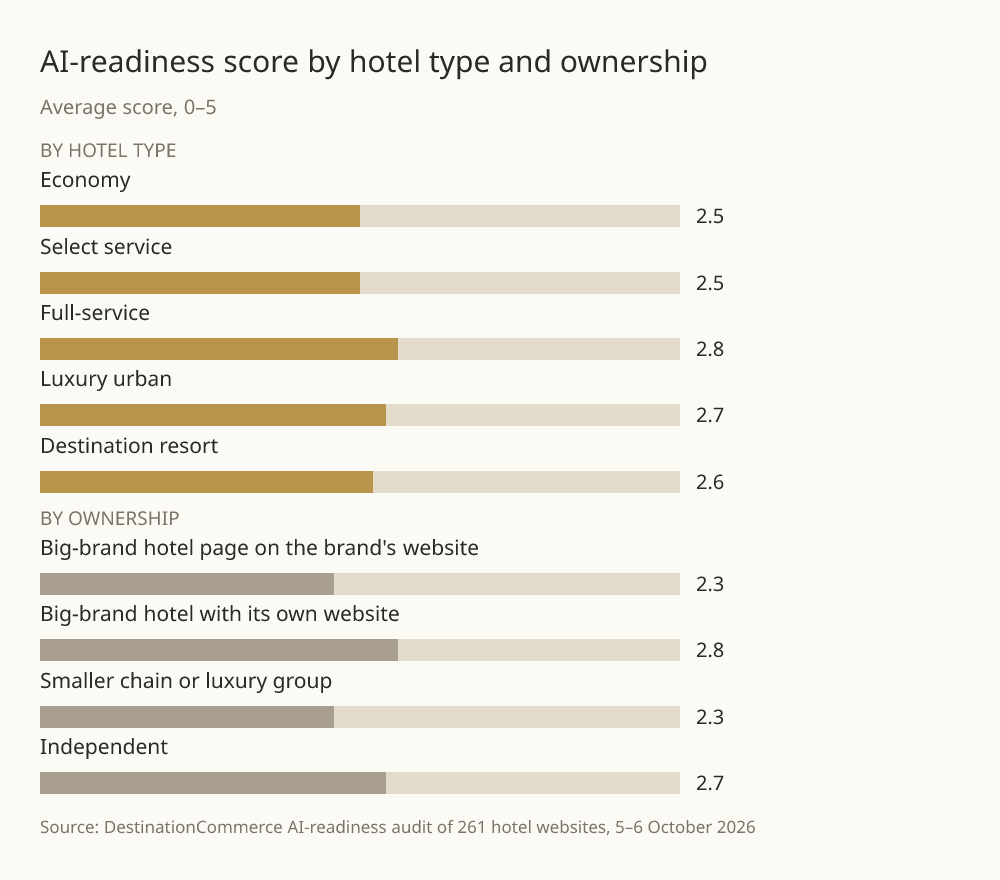
| Average AI-readiness score (0–5) | 2.7 |
The problem isn't that hotels shut AI out. It's what AI finds when it arrives: spa, dining and activity pages with no prices, no dates and nothing to book. An AI assistant can recommend a hotel's spa, but it can't tell a guest what a treatment costs or book one, so it points them to a platform that can.
Finding 6: The gap is the same for every kind of hotel
By hotel type:
| Economy | Select service | Full-service | Luxury urban | Destination resort | |
|---|---|---|---|---|---|
| Hotels | 21 | 33 | 79 | 51 | 77 |
| llms.txt | 29% | 27% | 43% | 29% | 34% |
| Structured data about the hotel | 43% | 52% | 65% | 61% | 56% |
| Experience pages showing any price | 1 of 8 | 18% | 15% | 18% | 8% |
| AI-readiness score (0–5) | 2.5 | 2.5 | 2.8 | 2.7 | 2.6 |
Readiness doesn't rise with hotel class. Full-service hotels lead on almost every measure, and resorts show a price on fewer experience pages than any other type, even though they typically have the most to sell.
By ownership:
| Big-brand hotel page on the brand's website | Big-brand hotel with its own website | Smaller chain or luxury group | Independent | |
|---|---|---|---|---|
| Hotels | 21 | 39 | 26 | 175 |
| llms.txt | 14% | 28% | 38% | 38% |
| Structured data about the hotel | 90% | 69% | 35% | 55% |
| Homepage mostly empty without JavaScript | 75%* | 21% | 46% | 27% |
| AI-readiness score (0–5) | 2.3 | 2.8 | 2.3 | 2.7 |
*Of 8 pages we could measure; treat as indicative.
- Big-brand hotel pages are the best labelled, but the least likely to have an llms.txt. They carry the most structured data, and on the pages we could measure most content only appeared after JavaScript ran.
- Some big-brand sites turn away automated visitors. Hotel pages on two of the largest brand websites refused our automated browser on every visit (44 pages, excluded from the figures), while loading normally for a person. That kind of bot protection may also stop AI agents that browse on a guest's behalf.
- Branded hotels with their own website score highest.
- Independents are just as open to AI as the brands, more likely to have an llms.txt, and just as unlikely to show bookable prices.
At brand level, none of the 18 hotel-brand websites we checked blocks AI search tools. Five (IHG, Choice, Wyndham, Accor and Radisson) publish an llms.txt.
Finding 7: Hotels that market experiences reach more new guests
| Hotels grouped by share of search visits landing on experience pages | Median experience share | Median share of visits from people not searching the hotel's name |
|---|---|---|
| Lowest quarter | 2% | 4% |
| Second quarter | 8% | 5% |
| Third quarter | 16% | 11% |
| Top quarter | 37% | 24% |
Hotels whose experience pages attract search traffic reach far more travelers who haven't chosen a hotel yet. Hotels that AI assistants named in our test also had higher experience-page shares (median 28%, against 12% for hotels they didn't name; 15 hotels named). These are associations: our data doesn't show that experience pages cause the extra reach.
How much more could a typical hotel reach? We modelled what would happen if each hotel published and marketed pages for the easier-to-win local experience searches in its city.
| Scenario | Assumption | Median extra search visits / month | Median vs today |
|---|---|---|---|
| Low | position 10 on 10% of those searches | +100 | +3% |
| Mid | position 8 on 25% | +320 | +10% |
| High | position 5 on 50% | +1,280 | +41% |
DropDesk model estimates, not forecasts. They measure search reach only, not bookings or revenue. "Easier-to-win" = Ahrefs Keyword Difficulty 10 or below and 1,500 searches a month or fewer.
What hotels can do
- Give every experience its own page: spa, dining, pool, events and activities, written for the questions guests actually search.
- Put the price and the booking on the page. Show what it costs and let guests book, in text that's visible without JavaScript.
- Describe offers in structured data (Event, Offer, price), so search engines and AI can read them.
- Keep AI search tools allowed, and add an llms.txt that points to the experience pages.
- Include local partners. Guests search for the whole destination, not just the property.
This is the idea behind destination commerce: when guests start with what they'll do, the hotel that sells it gets found first.
Best in class
Hotels with dedicated experience pages that also appeared in AI assistants' answers in our test (checked by an independent auditor, October 2026):
- Chicago Athletic Association (Chicago): an events page with bookable experiences and prices shown on its own website.
- Hotel Washington (Washington, DC): dedicated spa, dining and things-to-do pages, structured data for the hotel and spa, AI search tools allowed and an llms.txt guide.
- Le Sirenuse (Positano): dedicated pages for activities and excursions, wellness, and its restaurants and bars.
- The Mulia (Bali): dedicated spa and romance experience pages, with a reservation request on its own website.
Methodology
- Search demand: Ahrefs Keywords Explorer, U.S. Google monthly search volume, October 2026. 25 destinations from our Hotel Experiences Report 2026, 16 phrasings each. Search volume shows the scale of interest, not the order in which a traveler searches.
- Google results: Ahrefs SERP snapshot, 4 October 2026, top-10 organic results for "things to do in [city]", 15 U.S. cities.
- Hotel-name searches: every Google search containing the hotel's name (Ahrefs). 65 hotels with a distinctive name; generic and unrelated searches removed; topics assigned by keyword rules; a blind second auditor agreed on whether 92% of a 60-search sample were about experiences or rooms.
- Hotel search traffic: Ahrefs Site Explorer estimates for 94 single-property hotel websites. Experience pages identified from page addresses; a blind second auditor agreed on 58 of 60 sampled pages.
- AI answers: ChatGPT (with web search), Perplexity and Gemini (with Google grounding), queried through their APIs on 5 October 2026. 25 destinations × 7 questions, one run each. Answers coded with AI assistance. A second auditor re-ran 10 ChatGPT prompts in the consumer app and reached the same conclusion on 8 of 10. AI answers vary between runs and between apps and APIs.
- AI readiness: 314 hotel websites drawn from our Hotel Experiences and Hotel Day Pass report samples, visited 5–6 October 2026, with a second automated pass on 5 October to read llms.txt files behind redirects and structured data added by JavaScript. 261 analysed; 44 pages that refused automated browsers (mostly on two major brand websites) and 9 unreachable sites excluded. Waves 2–3 were stratified to cover all hotel types, so totals describe this sample rather than the whole industry.
- Hotel types: the five archetypes from the Hotel Experiences Report. Ownership comes from brand affiliation and website.
- Full definitions, data and a script that reproduces every number are available on request.
- Independent check: before publication, a second auditor re-checked a blind sample by hand: 34 hotel websites, 14 big-brand hotel pages, 10 AI answers in the ChatGPT app, 5 live Google searches, and 120 search-topic and page classifications. Agreement was 92–100% on every website check; no hotel website appeared in the live Google results. We corrected our figures where the auditor found errors (details available on request).
Free to use with a link to this page. Media contact: hello@destinationcommerce.ai · Graham Beck is available for interview.
Related research: The Hotel Experiences Report · The Hotel Day Pass Report · Experiential Travel Statistics 2026
FAQ
- Do travelers search for experiences or hotels more?
- Across 25 major destinations, Americans search for things to do about 1.3 times as often as for hotels (DestinationCommerce analysis of Ahrefs data, October 2026).
- Do AI assistants recommend hotels for things to do?
- Rarely for general questions: only 15% of AI answers to "best things to do in [city]" mentioned any hotel. Hotel websites supplied 5% of the sources AI cited for experience questions.
- Do AI assistants tell people to book hotel day passes directly?
- Fewer than 1 in 10 answers (8%) did. Most pointed to a day-access marketplace or another booking platform.
- Do hotels block AI crawlers?
- Almost never. Only 1 of 261 hotel websites blocked AI search tools (it blocks all crawlers), and 34% had an llms.txt file. About 7% ask AI systems not to train on their content while still allowing AI search. But only 1 of 147 experience pages gave AI a real price in structured data.
- How can a hotel improve its AI visibility?
- Give each experience its own page with a visible price and booking option, describe offers in structured data, keep AI search tools allowed, and add an llms.txt.